
 To enhance service speed and avoid tariff delays, we've opened a US warehouse. All US orders ship directly from our US facility.
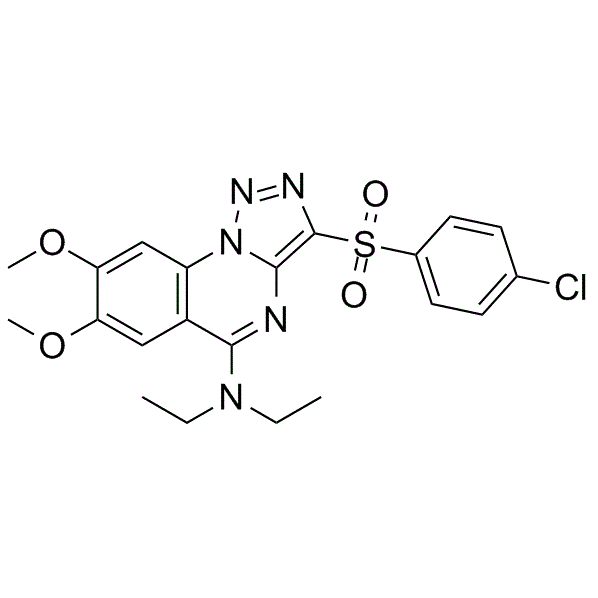




| Cas No.: | 1200443-21-5 |
| Chemical Name: | 3-((4-chlorophenyl)sulfonyl)-N,N-diethyl-7,8-dimethoxy-[1,2,3]triazolo[1,5-a]quinazolin-5-amine |
| SMILES: | COC1=CC2=C(C=C1OC)C(N(CC)CC)=NC3=C(S(=O)(C4=CC=C(Cl)C=C4)=O)N=NN32 |
| Formula: | C21H22ClN5O4S |
| M.Wt: | 475.95 |
| Purity: | >98% |
| Sotrage: | 2 years -20°C Powder, 2 weeks 4°C in DMSO, 6 months -80°C in DMSO |
| Description: | Targocil functions as a bacteriostatic inhibitor of wall teichoic acid (WTA) biosynthesis which can inhibit the growth of methicillin-susceptible S. aureus (MSSA) and methicillin-resistant S. aureus (MRSA) with MIC90s of 2 μg/ mL for both MRSA and MSSA. |
| Target: | MIC90: 2 μg/mL (MSSA), 2 μg/mL (MRSA)[1] |
| In Vitro: | MICs of Targocil against S. aureus strains Newman, MW2, MG2375, and MG2389 are 1 μg/mL for all strains. Targocil shows excellent activity against S. aureus isolates from suspected cases of bacterial keratitis, including both MSSA and MRSA isolates, with MICs that range from 1 to 2 μg/ mL. Targocil, a derivative of 1835F03, exhibits better activity against all keratitis isolates than the original lead compound, 1835F03. Bovine serum exhibits a detectable but moderate inhibitory effect on the in vitro antimicrobial activities of both 1835F03 and Targocil, increasing the MICs of both by 4- to 8-fold. Compare to the vehicle alone, Targocil at 5 μg/mL exhibits little toxicity for HCECs, even after 24 h of exposure. However, 40 μg/mL Targocil shows toxicity at all time points tested. Targocil at levels equal to 10×MIC in vitro readily inhibits growth of Newman and MG2375 in the presence of HCECs[1] |
| Cell Assay: | Log-phase strains MG2375, MG2389, Newman, and MW2 are collected and adjusted to a concentration of 2×10⁸ CFU/mL. After the treatment of bacterial cultures with Targocil at 10×MIC for 1 h, the cells are diluted 1:1,000 in fresh medium and then incubated and plated at the appropriate time points for viability determination. The postantibiotic effect (PAE) is calculated by the standard equation T-C, where T is the time required for the CFU count in the test culture to increase 10-fold above the count observed immediately after drug removal, and C is the time required for the count of the untreated control to increase 10-fold under the same conditions[1]. |
| References: | [1]. Suzuki T, et al. In vitro antimicrobial activity of wall teichoic acid biosynthesis inhibitors against Staphylococcus aureus isolates. Antimicrob Agents Chemother. 2011 Feb;55(2):767-74. |