 To enhance service speed and avoid tariff delays, we've opened a US warehouse. All US orders ship directly from our US facility.
| Cat. No. | Product Name | Field of Application | Chemical Structure |
|---|---|---|---|
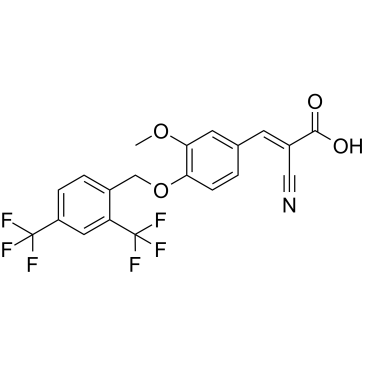
| DC26134 | PROTAC ERRα ligand 2 Featured |
PROTAC ERRα ligand 2 is an estrogen-related receptor α (ERRα) inverse agonist with an IC50 of 5.67 nM. PROTAC ERRα ligand 2 (IC50=5.67 nM) displays a ~11-fold improved potency than XCT790 (IC50=61.3 nM)[1].
More description
|
|
| DC9959 | Endoxifen (E-isomer) Featured |
Endoxifen (E-isomer hydrochloride) is a tamoxifen metabolite and potent Selective Estrogen Response Modifier (SERM).
More description
|

|
| DC8265 | Endoxifen Featured |
Endoxifen is a Estrogen receptor α (ERα) ligand; potent antiestrogen,an active metabolite of the cancer drug tamoxifen.
More description
|

|
| DC48003 | DS20362725 |
DS20362725 is an estrogen-related receptor α (ERRα) agonist. DS20362725 inhibits the binding between receptor-interacting protein 140 (RIP140) corepressor peptide (10 nM) and GST-ERRα ligand-binding domain (LBD; 1.2 μM) with an IC50 value of 0.6 μM. DS20362725 can be used for the research of metabolic disorders, including type 2 diabetes mellitus (T2DM).
More description
|

|
| DC48002 | DS45500853 |
DS45500853 is an estrogen-related receptor α (ERRα) agonist. DS45500853 inhibits the binding between receptor-interacting protein 140 (RIP140) corepressor peptide (10 nM) and GST-ERRα ligand-binding domain (LBD; 1.2 μM) with an IC50 value of 0.80 μM. DS45500853 can be used for the research of metabolic disorders, including type 2 diabetes mellitus (T2DM).
More description
|
|
| DC47981 | hFSH-β-(33-53) (TFA) |
hFSH-β-(33-53) TFA, a thiol-containing peptide which corresponds to a second FSH receptor-binding domain, is a FSHR (follicle-stimulating hormone receptor) antagonist. hFSH-β-(33-53) TFA inhibits binding of FSH to receptor and is a partial agonist of estradiol synthesis in Sertoli cells.
More description
|
|
| DC47661 | Estrone sulfate sodium |
Estrone sulfate, a biologically inactive form of estrogen, is a major circulating plasma estrogen that is converted into the biologically active estrogen, estrone (E1) by steroid sulfatase (STS). strone sulfate can be used for the research of breast cancer.
More description
|
|
| DC47238 | Rintodestrant |
Rintodestrant (G1T48) is an orally active, non-steroidal and selective estrogen receptor degrader. Rintodestrant (G1T48) is also a CDK4/6 inhibitor.
More description
|
|
| DC46490 | GNE-502 |
GNE-502 is an orally active and potent degrader for estrogen receptor (ER). GNE-502 can be used for the research of breast cancer.
More description
|
|
| DC46033 | Miroestrol |
Miroestrol is a highly active phytoestrogen. Miroestrol can produce mammogenic effect. Miroestrol exhibits bone loss prevention and neuroprotective in ovariectomized mice. Miroestrol also can reduce cancer risk.
More description
|
|
| DC45979 | GNE-274 |
GNE-274 is a non-degrader that is structurally related to GDC-0927 (ER degrader). GNE-274 does not induce ER turnover and functions as a partial ER agonist in breast cancer cell lines. GNE-274 increase chromatin accessibility at ER-DNA binding sites, while GDC-0927 do not. GNE-274 is a potent inhibitor of ER-ligand binding domain (LBD). GNE-274 can be used for cancer research.
More description
|
|
| DC45775 | Arzoxifene |
Arzoxifene (LY353381) is an orally active selective estrogen receptor modulator with a fixed ring structure similar to raloxifene. Arzoxifene has minimal side effects with powerful antiestrogenic effects on breast cancer and endometrium, with equally strong favorable estrogenic effects on bone and lipid profile.
More description
|
|
| DC45378 | GPR30 agonist-1 |
GPR30 agonist-1 is a G protein-coupled receptor 30 (GPR30) agonist. GPR30 agonist-1 exerts vasorelaxant effects.
More description
|
|
| DC45316 | 4',2-Dihydroxy-4,6-dimethoxydihydrochalcone |
4',2-Dihydroxy-4,6-dimethoxydihydrochalcone, an estrogen agonist, shows binding affinity for bovine uterine estrogen receptor with an IC5050 of 15 μM.
More description
|
|
| DC44906 | Megestrol |
Megestrol, a synthetic progestin, is approved for the treatment of anorexia, cachexia, or an unexplained significant weight loss in patients with an acquired immunodeficiency syndrome diagnosis. Megestrol acetate (Megace) is one of the first progestational agents to be evaluated for use in the hormonal therapy of advanced breast cancer.
More description
|
|
| DC44740 | Allylestrenol |
Allylestrenol is an orally active progestagen of the 19-nortestosterone series resembling progesterone.
More description
|
|
| DC44515 | Phenol Red sodium salt |
Phenol Red sodium salt (Phenolsulfonephthalein sodium salt) is used ubiquitously as a pH indicator in tissue culture media ranging from 6.8 (yellow) to 8.2 (red). Phenol red binds to the estrogen receptor of MCF-7 human breast cancer cells.
More description
|
|
| DC41233 | Zuclomiphene D4 citrate |
Zuclomiphene D4 citrate is a deuterium labeled Zuclomiphene citrate. Zuclomiphene citrate has an antiestrogenic effect and can inhibit the secretion of luteinizing hormone (LH) more than the trans isomer. Zuclomiphene citrate is also an orally active hypocholesterolemic agent.
More description
|
|
| DC41153 | Bazedoxifene hydrochloride |
Bazedoxifene hydrochloride (TSE-424 hydrochloride) is an oral, BBB-penetrant nonsteroidal selective estrogen receptor modulator (SERM), with IC50s of 23 nM and 99 nM for ERα and ERβ, respectively. Bazedoxifene hydrochloride can be used for the research of osteoporosis. Bazedoxifene hydrochloride also acts as an inhibitor of IL-6/GP130 protein-protein interactions and can be used for the research of pancreatic cancer.
More description
|
|
| DC40506 | 4-Nonylphenol-D5 |
4-Nonylphenol-D5 (4-n-Nonylphenol-2,3,5,6-d4,OD) is the deuterium labeled 4-Nonylphenol. 4-Nonylphenol, a major degradation product of Nonylphenol ethoxylates (NPEOs), is a persistent organic pollutant with endocrine-disrupting properties and exerts estrogenic activity.
More description
|
|
| DC40164 | H3B-6545 hydrochloride |
H3B-6545 hydrochloride is an oral, selective estrogen receptor covalent antagonist (SERCA) for the research of metastatic ER-positive, HER2-negative breast cancer.
More description
|
|
| DC40163 | H3B-6545 |
H3B-6545 is an oral, selective estrogen receptor covalent antagonist (SERCA) for the research of metastatic ER-positive, HER2-negative breast cancer.
More description
|
|
| DC40137 | (E/Z)-GSK5182 |
(E/Z)-GSK5182 is a racemic compound of (E)-GSK5182 and (Z)-GSK5182 isomers. GSK5182 is a highly selective and orally active inverse agonist of estrogen-related receptor γ (ERRγ) with an IC50 of 79 nM. GSK5182 also induces reactive oxyen species (ROS) generation in hepatocellular carcinoma.
More description
|
|
| DC29171 | Cyclofenil |
Cyclofenil is a selective estrogen receptor modulator and an ovulation-inducing agent. Cyclofenil shows an inhibitory effect on dengue virus replication in Vero cells with an EC50 of 1.62 μM. Cyclofenil has anti-dengue-virus activity.
More description
|
|
| DC29075 | Chlorotrianisene |
Chlorotrianisene is a long-acting non-steroidal estrogen and an orally active estrogen receptor modulator. Chlorotrianisene exhibits antiestrogenic activity. Chlorotrianisene potently inhibits the enzyme COX-1 and inhibits platelet aggregation in whole blood.
More description
|
|
| DC29061 | Zuclomiphene citrate |
Zuclomiphene citrate is a cis isomer of Clomiphene citrate. Zuclomiphene citrate has an antiestrogenic effect and can inhibit the secretion of luteinizing hormone (LH) more than the trans isomer. Zuclomiphene citrate is also an orally active hypocholesterolemic agent.
More description
|
|
| DC28987 | (Rac)-Acolbifene |
(Rac)-Acolbifene (EM-343; (Rac)-EM-652) is the racemic form of EM652 (estrogen receptor antagonist), has anti-estrogenic and estrogenic activities. (Rac)-Acolbifene (EM-343; (Rac)-EM-652) contains a piperidine ring, shows good pharmacological profile,relative binding affinity (RBA)=380.
More description
|
|
| DC28885 | 6-Raloxifene-β-D-glucopyranoside |
6-Raloxifene-β-D-glucopyranoside, a derivative of Raloxifene, is a benzothiophene glucuronidated at the 6' postion. 6-Raloxifene-β-D-glucopyranoside is a selective and orally active estrogen receptor antagonist. 6-Raloxifene-β-D-glucopyranoside can be used for inhibiting bone loss and resorption, and lowering lipid levels. 6'-Raloxifene-β-D-glucopyranoside, compound Ia, is extracted from patent US5567820A.
More description
|
|
| DC28884 | 4'-Raloxifene-β-D-glucopyranoside |
4'-Raloxifene-β-D-glucopyranoside, a metabolite of Raloxifene, is a benzothiophene glucuronidated at the 4' postion. 4'-Raloxifene-β-D-glucopyranoside is a selective and orally active estrogen receptor antagonist. 4'-Raloxifene-β-D-glucopyranoside can be used for inhibiting bone loss and resorption, and lowering lipid levels. 4'-Raloxifene-β-D-glucopyranoside, example 5, is extracted from patent US5567820A.
More description
|
|
| DC28880 | Raloxifene 4-Monomethyl Ether |
Raloxifene 4-Monomethyl Ether (Compound 37) is a Raloxifene derivative that inhibits estrogen receptor α. Raloxifene 4-Monomethyl Ether inhibits MCF-7 cells with an IC50 of 1 μM and a pIC50 of 6.
More description
|
|
