Alternate TextTo enhance service speed and avoid tariff delays, we've opened a US warehouse. All US orders ship directly from our US facility.
ST12

  Cat. No.:  DC60980   Featured
Chemical Structure
For research use only. We do not sell to patients.
We match the best price and quality on market.
Email:order@dcchemicals.com  sales@dcchemicals.com
Tel:+86 21 58447131
We are official vendor of:
  • 20
  • 19
  • 18
  • 17
  • 16
  • 15
  • 14
  • 12
  • 11
  • 10
  • 9
  • 8
  • 13
  • 6
  • 5
  • 4
  • 3
  • 2
  • 1
More than 5000 active chemicals with high quality for research!
Field of application
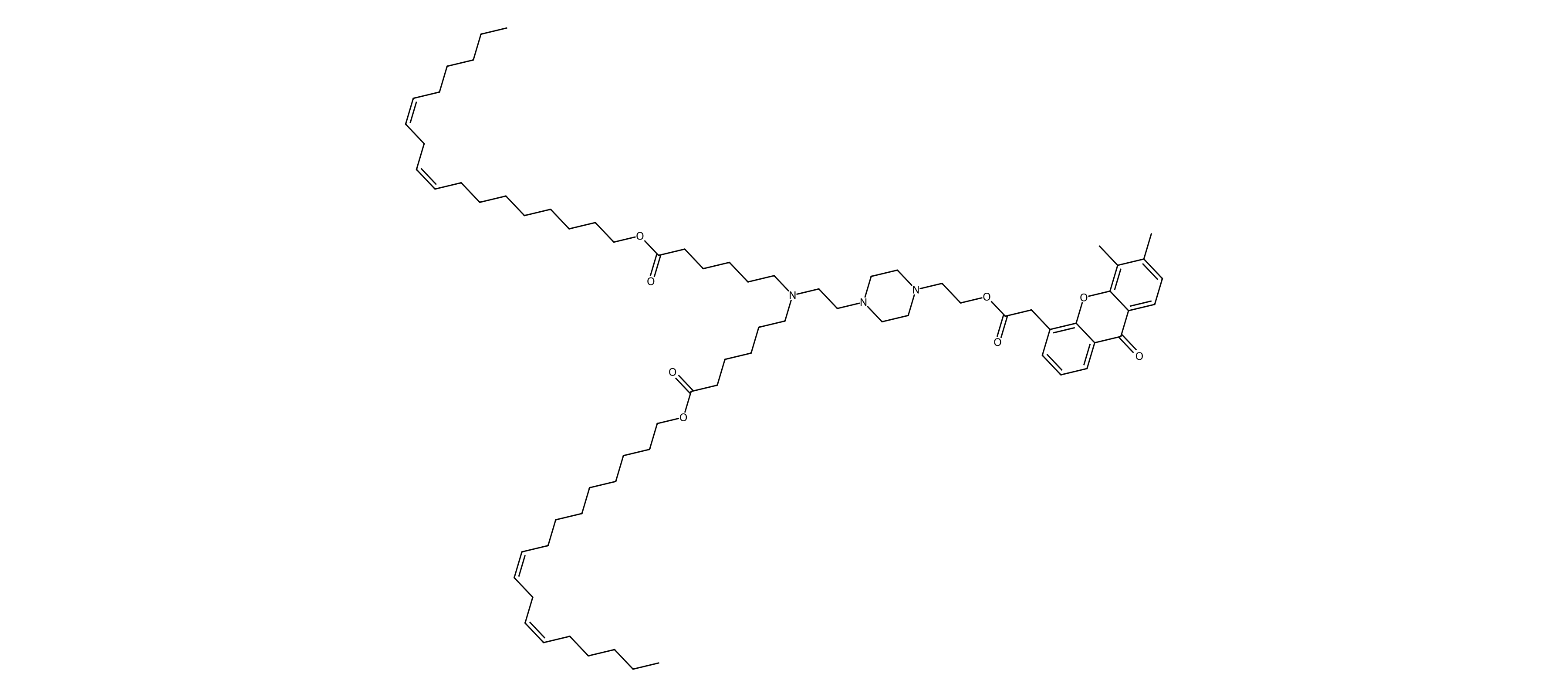
ST12 is a lipid-conjugated DMXAA prodrug designed for temporally controlled STING activation in mRNA vaccine formulations. Its structure integrates a mouse-specific STING agonist, a biodegradable ester linker, an RNA-interacting tertiary amine domain, and two hydrophobic tails. When incorporated as a partial replacement for SM-102, ST12 preserves early antigen mRNA translation and subsequently releases DMXAA to activate STING. This delayed activation supports localized type I interferon signaling, enhanced antigen-specific CD8-positive T-cell responses, and improved antitumor immunity. In preclinical OVA and HPV tumor models, ST12-based Syn-STING vaccines suppressed tumor growth and prolonged survival. ST12 remains a preclinical research lipid developed specifically around DMXAA-sensitive STING systems.
Cas No.:
Purity: 98%
Sotrage: 2 years -20°C Powder, 2 weeks 4°C in DMSO, 6 months -80°C in DMSO
Publication: Qin P, Qin Q, Hao Y, et al. Enhanced antitumor immunity of mRNA vaccines by bioorthogonal-like delayed activation of exogeneous STING. Nature Biotechnology. 2026.
Cat. No. Product name Field of application
DC60980 ST12 ST12 is a lipid-conjugated DMXAA prodrug designed for temporally controlled STING activation in mRNA vaccine formulations. Its structure integrates a mouse-specific STING agonist, a biodegradable ester linker, an RNA-interacting tertiary amine domain, and two hydrophobic tails. When incorporated as a partial replacement for SM-102, ST12 preserves early antigen mRNA translation and subsequently releases DMXAA to activate STING. This delayed activation supports localized type I interferon signaling, enhanced antigen-specific CD8-positive T-cell responses, and improved antitumor immunity. In preclinical OVA and HPV tumor models, ST12-based Syn-STING vaccines suppressed tumor growth and prolonged survival. ST12 remains a preclinical research lipid developed specifically around DMXAA-sensitive STING systems.
X