Alternate TextTo enhance service speed and avoid tariff delays, we've opened a US warehouse. All US orders ship directly from our US facility.
THP1

  Cat. No.:  DC60671  
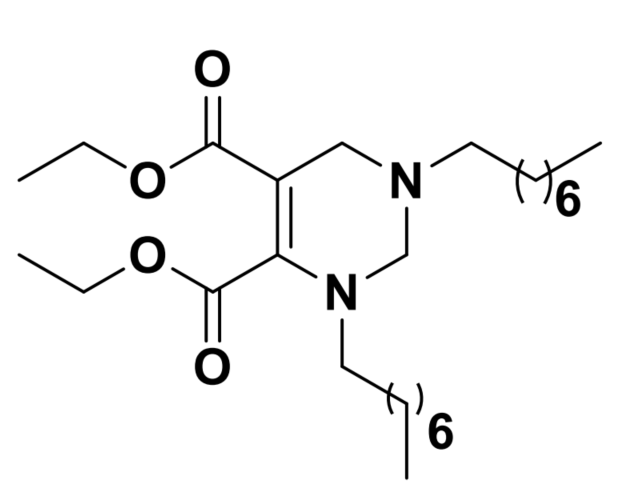
Chemical Structure
For research use only. We do not sell to patients.
We match the best price and quality on market.
Email:order@dcchemicals.com  sales@dcchemicals.com
Tel:+86 21 58447131
We are official vendor of:
  • 20
  • 19
  • 18
  • 17
  • 16
  • 15
  • 14
  • 12
  • 11
  • 10
  • 9
  • 8
  • 13
  • 6
  • 5
  • 4
  • 3
  • 2
  • 1
More than 5000 active chemicals with high quality for research!
Field of application
THP1 is a tetrahydropyrimidine ionizable lipid for mRNA delivery. THP1 demonstrates higher transfection efficiency comparable to DLin-MC3-DMA (MC3). THP1 LNPs also demonstrates the ability to edit genes in specific liver tissues in a tdTomato transgenic mouse model.
Cas No.:
Chemical Name: THP1
Synonyms: THP-1,, THP 1
SMILES: O=C(OCC)C1=C(C(OCC)=O)N(CCCCCCCC)CN(CCCCCCCC)C1
Formula: C26H48N2O4
M.Wt: 452.68
Purity: 98%
Sotrage: 2 years -20°C Powder, 2 weeks 4°C in DMSO, 6 months -80°C in DMSO
Cat. No. Product name Field of application
DC67662 Lipid 48 (CC14-L2-T14) Lipid 48​ is a leading ionizable lipid designed for therapeutic nucleic acid delivery. Its key function is to form the core of lipid nanoparticles (LNPs) that efficiently encapsulate and deliver cargoes like mRNA and CRISPR guide RNAs into cells. Its optimized structure allows it to remain neutral in the bloodstream for low toxicity but become positively charged in acidic cellular compartments (endosomes), where it disrupts the membrane to release the therapeutic payload. Data from the patent demonstrates its superior profile: it achieves high gene editing efficiency (e.g., ~80% indel rates in vitro and 16.2% in vivo in mouse liver) while maintaining low cytotoxicity (cell viability >80% at effective doses), establishing it as an ideal candidate for gene therapy applications due to its exceptional balance of potency and safety.
DC60825 11-10-8 11-10-8 is an ionizable cationic lipid (pKa = 6.22) that has been used in the generation of lipid nanoparticles (LNPs) for mRNA delivery in vivo.1 LNPs containing 11-10-8 and encapsulating mRNA encoding the Cas9 nuclease and small-guide RNA (sgRNA) targeting transthyretin (TTR), a thyroid hormone carrier protein, decrease serum levels of TTR in mice. LNPs containing 11-10-8 and encapsulating mRNA encoding human fibroblast growth factor 21 (hFGF21) increase serum levels of hFGF21, decrease body and liver weights, and reduce the liver steatosis score in a mouse model of obesity induced by a high-fat diet.
DC67298 Lipid 5D8 Lipid 5D8 is a novel biodegradable ionizable lipid (IL) developed through a combinatorial chemistry strategy to overcome the limitations of conventional lipid nanoparticles (LNPs) in mRNA delivery. Synthesized via a one-step, solvent-free Michael addition reaction between amine and thiol monomers, 5D8 features asymmetric lipid tails and a biodegradable ester backbone, ensuring both structural versatility and reduced toxicity. In preclinical studies, 5D8-based LNPs demonstrated exceptional liver-targeting efficiency and mRNA delivery performance. A single intravenous dose (1 mg/kg) achieved 61% CRISPR-Cas9-mediated editing of the TTR gene in mice, reducing serum TTR protein by 90%, outperforming benchmark lipids like C12-200 (51% editing). Moreover, 5D8 enabled efficient delivery of base editors (ABE8.8 and CBE4max), achieving 42% PCSK9 editing (74% serum protein reduction) and correcting hereditary tyrosinemia in mice, significantly extending survival. Beyond gene editing, 5D8 LNPs effectively delivered siRNA (complete serum TTR clearance at 0.05 mg/kg) and enhanced hepatocyte targeting by enriching apolipoprotein E on particle surfaces. Crucially, 5D8 exhibited superior biocompatibility with no hepatotoxicity (normal ALT/AST levels), contrasting traditional LNPs. Its rapid biodegradability and "plug-and-play" design make 5D8 a versatile platform for mRNA therapeutics, holding broad potential for treating genetic disorders, cardiovascular diseases, and beyond. This innovation represents a critical advancement toward safer, high-efficiency clinical translation of gene-editing therapies.L
DC60671 THP1 THP1 is a tetrahydropyrimidine ionizable lipid for mRNA delivery. THP1 demonstrates higher transfection efficiency comparable to DLin-MC3-DMA (MC3). THP1 LNPs also demonstrates the ability to edit genes in specific liver tissues in a tdTomato transgenic mouse model.
DC49932 FTT5 FTT5 is a lipid-like compound for efficient delivery of long mRNAs in vivo.
X