 To enhance service speed and avoid tariff delays, we've opened a US warehouse. All US orders ship directly from our US facility.
| Cat. No. | Product Name | Field of Application | Chemical Structure |
|---|---|---|---|
| DC40738 | (Rac)-Benpyrine Featured |
(Rac)-Benpyrine, a racemate of Benpyrine, is a potent and orally active TNF-α inhibitor. (Rac)-Benpyrine has the potential for TNF-α mediated inflammatory and autoimmune disease research.
More description
|

|
| DC8475 | A-1210477 Featured |
A-1210477 is a potent and selective MCL-1 inhibitor.
More description
|

|
| DC8232 | AZD5582 Featured |
AZD5582 is a novel class of dimeric Smac mimetics as potent IAP antagonist; binds potently to the BIR3 domains of cIAP1, cIAP2, and XIAP (IC50 = 15, 21, and 15 nM, respectively).
More description
|

|
| DC9695 | BH3I-1 Featured |
BH3I-1 is a cell permeable BH3 mimetic that binds to Bcl-xL. BH3I-1 is an inhibitor of Bcl-xL.
More description
|

|
| DC7563 | BV6 Featured |
BV6 induced apoptotic and necrotic cell death in monocytes while T-cells, dendritic cells and
macrophages were largely protected against BV6-induced cell death.
More description
|

|
| DC48419 | MA242 free base |
MA242 free base is a specific dual inhibitor of MDM2 and NFAT1. MA242 free base directly binds both MDM2 and NFAT1 with high affinity, induces their protein degradation, and inhibits NFAT1-mediated transcription of MDM2. MA242 free base induces apoptosis in pancreatic cancer cell lines regardless of p53 status.
More description
|

|
| DC48386 | ABBV-167 |
ABBV-167 is a phosphate prodrug of the BCL-2 inhibitor venetoclax.
More description
|
|
| DC48114 | TNF-α-IN-6 |
TNF-α-IN-6 is an orally efficacious allosteric inhibitor of TNFα (KD = 6.8 nM).
More description
|
|
| DC48113 | TNIK-IN-3 |
TNIK-IN-3 is a potent, selective and orally active inhibitor of Traf2- and Nck-interacting protein kinase (TNIK), with an IC50 of 0.026 μM. TNIK-IN-3 could also inhibit Flt4 (IC50=0.030 μM), Flt1 (IC50=0.191 μM) and DRAK1 (IC50=0.411 μM). TNIK-IN-3 can be used for the research of colorectal cancer.
More description
|
|
| DC48111 | Antitumor agent-37 |
Antitumor agent-37 possesses potent anti-proliferative and anti-metastasis activities. Antitumor agent-37 induces serious DNA damage and further leads to high expression of γ-H2AX and p53. Antitumor agent-37 promotes apoptosis of tumor cells through mitochondrial apoptotic pathway Bcl-2/Bax/caspase3. Antitumor agent-37 significantly improves immune response through restraining the expression of PD-L1 to increase CD3+ and CD8+ T infiltrating cells in tumor tissues.
More description
|
|
| DC48110 | S-Allylmercaptocysteine |
S-allylmercaptocysteine, an organic sulfur compound extracted from garlic, has anti-inflammatory and anti-oxidative effects for various pulmonary diseases. S-allylmercaptocysteine achieves its anti-cancer effect through a variety of pathways such as inducing the apoptosis of cancer cells through the TGF-β signaling pathway, or reducing the NF-κB activity and up-regulating Nrf2 to achieve the effects of anti-inflammation and anti-oxidation.
More description
|
|
| DC48109 | Verrucarin J |
Verrucarin J (Muconomycin B) is a metabolite of the Myrothecium fungus family. Verrucarin J generates reactive oxygen species (ROS) and induces apoptosis of cancer cell lines, such as A549, HCT 116 and SW-620 cells. Verrucarin J shows activities against Candida albicans and Mucor miehei. Verrucarin J inhibits arenavirus Junin (JUNV) yield with an IC50 of 1.2 ng/mL.
More description
|
|
| DC48108 | Antitumor agent-36 |
Antitumor agent-36 possesses potent anti-proliferative and anti-metastasis activities. Antitumor agent-36 induces serious DNA damage and further leads to high expression of γ-H2AX and p53. Antitumor agent-36 promotes apoptosis of tumor cells through mitochondrial apoptotic pathway Bcl-2/Bax/caspase3. Antitumor agent-36 significantly improves immune response through restraining the expression of PD-L1 to increase CD3+ and CD8+ T infiltrating cells in tumor tissues.
More description
|
|
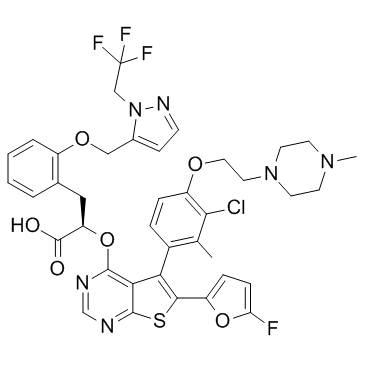
| DC10137 | S63845 Featured |
S63845 is a potent and selective myeloid cell leukemia 1 (MCL1) inhibitor; binds human MCL1 with a Kd of 0.19 nM.
More description
|
|
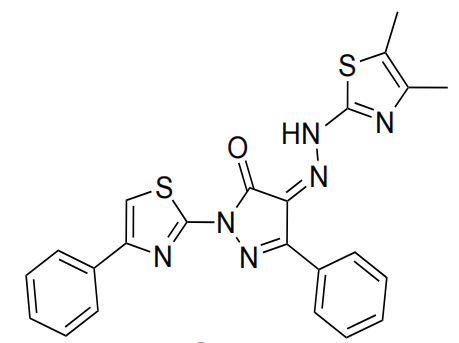
| DC59120 | BTSA1.2 Featured |
BTSA1.2 is a rationalized BTSA1 analog with improved binding to BAX, cellular cytotoxicity, and better toleratence in vivo. Combination of BTSA1.2 with Navitoclax demonstrates synergistic efficacy in apoptosis-resistant cancer cells, xenografts, and patient-derived tumors while sparing healthy tissues.
More description
|
|
| DC10133 | Gambogic Acid Featured |
Gambogic Acid activates caspases with EC50 of 0.78-1.64 μM and competitively inhibits Bcl-xl, Bcl-2, Bcl-w, Bcl-B, Bfl-1 and Mcl-1 with IC50 of 1.47 μM, 1.21 μM, 2.02 μM, 0.66 μM, 1.06 μM and 0.79 μM, respectively.
More description
|

|
| DC40142 | Ac-FLTD-CMK Featured |
Ac-FLTD-CMK, a gasdermin D (GSDMD)-derived inhibitor, is a specific inflammatory caspases inhibitor. Ac-FLTD-CMK is effective against caspases-1 (IC50 of 46.7 nM), caspases-4 (IC50 of 1.49 μM), caspases-5 (IC50 of 329 nM), and caspases-11 , but not the apoptotic caspases such as caspase-3.
More description
|

|
| DC11627 | KEA1-97 Featured |
KEA1-97 (KEA 1-97) is a small molecule that disrupts the interaction of thioredoxin with caspase 3.
More description
|

|
| DC7217 | Obatoclax (GX15-070) Featured |
Obatoclax (GX15-070) is Bcl-2 homology domain-3 (BH3) mimetic, antagonize all antiapoptotic Bcl-2 family proteins (average IC50, 3 umol/L), including Mcl-1 (IC50, 2.9 umol/L) and Bfl-1 (IC50, 5 umol/L).
More description
|

|
| DC7175 | JNJ-26854165 (Serdemetan) Featured |
JNJ-26854165 (Serdemetan) acts as a HDM2 ubiquitin ligase antagonist and also induces early apoptosis in p53 wild-type cells, inhibits cellular proliferation followed by delayed apoptosis in the absence of functional p53.
More description
|

|
| DC10041 | KR-33494 Featured |
KR-33494 is a fluorescent-tagged and biotin-tagged probe of a potent inhibitor for Fas-mediated cell death (FAF1), KR-33493.
More description
|

|
| DC10777 | Leonurine Featured |
Leonurine, a natural alkaloid extracted from Herba leonuri, has been proved to have anti-inflammatory effect.
More description
|

|
| DC48066 | 12-HETE |
12-HETE, a major metabolic product of arachidonic acid using 12-LOX catalysis, inhibits cell apoptosis in a dose-dependent manner. 12-HETE promotes the activation and nuclear translocation of NF-κB through the integrin-linked kinase (ILK) pathway.12-HETE has both anti-thrombotic and pro-thrombotic effects. 12-HETE is a neuromodulator.
More description
|
|
| DC48061 | 3-Campholenyl-2-butanol |
3-Campholenyl-2-butanol, a synthetic sandalwood odorant, is a selective olfactory receptor OR2AT4 agonist. 3-Campholenyl-2-butanol prolongs human hair growth ex vivo by decreasing apoptosis and increasing production of the anagen-prolonging growth factor IGF-1 in the outer root sheath (ORS).
More description
|
|
| DC48044 | Bcl-xL antagonist 2 |
Bcl-xL antagonist 2 is a potent, selective, and orally active antagonist of BCL-XL with an IC 50 of 0.091 μM. Bcl-xL antagonist 2 promotes the apoptosis of cancer cells. Bcl-xL antagonist 2 has the potential for the research of the chronic lymphocytic leukemia (CLL) and nonHodgkin’s lymphoma (NHL).
More description
|
|
| DC48011 | DB2115 tertahydrochloride |
DB2115 (tertahydrochloride) is a potent inhibitor of myeloid master regulator PU.1. DB2115 (tertahydrochloride) has the potential for the treatment of cancers, including hematologic cancers such as leukemia, as well as other conditions associated with PU. 1 dysfunction (extracted from patent WO2017223260A1, compound DB2115) .
More description
|
|
| DC47954 | M50054 |
M50054 is a potent inhibitor of apoptosis. M50054 inhibits Etoposide-induced caspase-3 activation of U937 cells with an IC50 of 79 μg/mL. M50054 does not directly inhibit the enzymatic activity of caspase-3. M50054 can be used for the research anti-Fas-antibody-induced hepatitis and chemotherapy-induced alopecia.
More description
|
|
| DC47907 | S65487 hydrochloride |
S65487 (VOB560) hydrochloride is a potent and selective Bcl-2 inhibitor. S65487 hydrochloride is also active on BCL-2 mutations, such as G101V and D103Y. S65487 hydrochloride has poor affinity with MCL-1, BFL-1 and BCL-XL. S65487 hydrochloride induces apoptosis and has anticaner activities.
More description
|
|
| DC47899 | SM-433 hydrochloride |
SM-433 hydrochlorid, a Smac mimetic, function as inhibitor of inhibitor of apoptosis proteins (IAPs). SM-433 hydrochlorid exhibits strong binding affinity XIAP BIR3 protein with an IC50<1 μM (patent WO2008128171A2).
More description
|
|
| DC47896 | Sparfosic acid |
Sparfosic acid is a DNA antimetabolite agent and a potent inhibitor of aspartate transcarbamoyl transferase. Sparfosic acid has anti-tumor activity. Aspartate transcarbamoyl transferase catalyzes the second step of de novo pyrimidine biosynthesis.
More description
|
|
