 To enhance service speed and avoid tariff delays, we've opened a US warehouse. All US orders ship directly from our US facility.
| Cat. No. | Product Name | Field of Application | Chemical Structure |
|---|---|---|---|
| DC49534 | RIPK1-IN-12 |
RIPK1-IN-12 is a potent RIPK1 inhibitor. RIPK1-IN-12 inhibits necroptosis in both human and mouse cells, with EC50 values of 1.6 and 2.9 nM, respectively.
More description
|

|
| DC49533 | ADH-6 |
ADH-6 is a tripyridylamide compound. ADH-6 abrogates self-assembly of the aggregation-nucleating subdomain of mutant p53 DBD. ADH-6 targets and dissociates mutant p53 aggregates in human cancer cells, which restores p53's transcriptional activity, leading to cell cycle arrest and apoptosis. ADH-6 has the potential for the research of cancer diseases.
More description
|
|
| DC49532 | IM-93 |
IM-93 inhibits ferroptosis and NETosis with an IC< sub>50 of 0.45 µM for cell death inhibition.
More description
|
|
| DC49531 | hGGPPS-IN-3 |
hGGPPS-IN-3 (Compound 13h) is a potent inhibitor of the human geranylgeranyl pyrophosphate synthase (hGGPPS). hGGPPS-IN-3 is an analogue of C-2-substituted thienopyrimidine-based bisphosphonates (C2-ThP-BPs). hGGPPS-IN-3 induces target-selective apoptosis of multiple myeloma (MM) cells and exhibits antimyeloma activity in vivo.
More description
|
|
| DC49530 | Tricetin |
Tricetin is a potent competitive inhibitor of the Keap1-Nrf2 Protein Protein Interaction (PPI). Tricetin significantly improves cell viability and suppresses mitochondria-mediated apoptosis. Tricetin also induced the protein expression of Nuclear factor (erythroid-derived 2)-like 2 (Nrf2) and its transcriptional activation, resulting in the up-regulated expression of heme oxygenase-1 (HO-1), which conferred neuroprotection against 6-OHDA-induced oxidative damage. Tricetin has the potential for the research of Parkinson's disease (PD).
More description
|
|
| DC49529 | NCX4040 |
NCX4040 (NO-Aspirin), a non-steroidal anti-inflammatory drug (NSAID), is a nitric oxide (NO) releasing form of Aspirin. NCX4040 induces apoptosis in PC3 metastatic prostate cancer cells. NCX4040 has anti-inflammatory and anti-cancer effects.
More description
|
|
| DC49528 | Anticancer agent 39 |
Anticancer agent 39 (compound B12), a fluorescent derivative of Jiyuan Oridonin A (JOA), induces the collapse of mitochondrial membrane potential (MMP)and thus induced apoptosis.Anticancer agent 39 inhibits cell cloning and migration.Anticancer agent 39 exhibits promising anti-proliferative activity against HGC-27 cells with IC50 value of 0.39 μM.
More description
|
|
| DC49527 | Autophagy inducer 2 |
Autophagy inducer 2 (Compound 11i) is a potent autophagy inducer. Autophagy inducer 2 exhibits apparent antiproliferative activity against the MCF-7 cell line with an IC50 value of 1.31 μM and remarkably inhibits the colony formation of the MCF-7 cells. Autophagy inducer 2 arrests the MCF-7 cells in the G2/M phase by regulating the cell-cycle-related proteins Cdk-1 and Cyclin B1. Autophagy inducer 2 has the potential for the research of breast cancer.
More description
|
|
| DC49526 | Physalin A |
Physalin A is a withanolide isolated from Physalis alkekengi var. franchetii. Physalin A induces apoptosis associated with up-regulation of caspase-3 and caspase-8 expression. Physalin A induces autophagy, found to antagonize apoptosis in HT1080 cells. Physalin A has the potential for the research of cancer disease.
More description
|
|
| DC49525 | hGGPPS-IN-2 |
hGGPPS-IN-2 (Compound 16g) is a potent inhibitor of the human geranylgeranyl pyrophosphate synthase (hGGPPS). hGGPPS-IN-2 is an analogue of C-2-substituted thienopyrimidine-based bisphosphonates (C2-ThP-BPs). hGGPPS-IN-2 induces target-selective apoptosis of multiple myeloma (MM) cells and exhibits antimyeloma activity in vivo.
More description
|
|
| DC49524 | Petromurin C |
Petromurin C is a bisindolylbenzenoid compound isolated from the ascostromata of Petromycesmuricatus. Petromurin C induces protective autophagy and apoptosis in FLT3-ITD-positive AML.
More description
|
|
| DC49523 | 27-Methyl withaferin A |
27-Methyl withaferin A (comppund 26) is an apoptosis inducer with anticancer effects. 27-Methyl withaferin A shows antiproliferative effects against HeLa, A-549 and MCF-7 human tumor cell lines with IC50 values of 3.2 μM, 4.2 μM and 1.4 μM, respectively.
More description
|
|
| DC49522 | hGGPPS-IN-1 |
hGGPPS-IN-1 (Compound 18b) is a potent inhibitor of the human geranylgeranyl pyrophosphate synthase (hGGPPS). hGGPPS-IN-1 is an analogue of C-2-substituted thienopyrimidine-based bisphosphonates (C2-ThP-BPs). hGGPPS-IN-1 induces target-selective apoptosis of multiple myeloma (MM) cells and exhibits antimyeloma activity in vivo.
More description
|
|
| DC49521 | 27-O-(tert-Butyldimethylsilyl)withaferin A |
27-O-(tert-Butyldimethylsilyl)withaferin A (compound 9a), a natural withanolide, is an apoptosis inducer. 27-O-(tert-Butyldimethylsilyl)withaferin A shows antiproliferative activity against HeLa, A-549 and MCF-7 human cancer cell lines, and against normal Vero cells.
More description
|
|
| DC49520 | AK-778-XXMU |
AK-778-XXMU is a potent inhibitor of DNA Binding 2 (ID2) antagonist with a KD of 129 nM. AK-778-XXMU can inhibit cell migration and invasion of glioma cell lines, induce apoptosis, and more importantly, slow down the tumor growth.
More description
|
|
| DC49412 | Z-DEVD-AFC |
Z-DEVD-AFC is a cell-permeant substrate for caspase-3, which causes a shift in fluorescence uponcleavage of the AFC fluorophore. Z-DEVD-AFC can be used to detect caspase-3-like enzymes activity.
More description
|
|
| DC49411 | Malformin A1 |
Malformin A1, a cyclic pentapeptide isolated from Aspergillus niger, possess a range of bioactive properties including antibacterial activity. Malformin A1 shows potent cytotoxic activities on human colorectal cancer cells. Malformin A1 induces apoptosis by activating PARP, caspase 3, -7, and -9.
More description
|
|
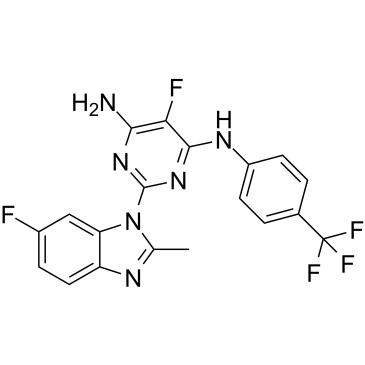
| DC28030 | PTC596 Featured |
PTC596 is an orally active and selective B-cell-specific Moloney murine leukemia virus integration site 1 (BMI-1) inhibitor. PTC596 targets BMI1 expressed by both tumor cells and cancer stem cells (CSCs), and induces hyper-phosphorylation of BMI1, leading to its degradation. PTC596 downregulates MCL-1 and induces p53-independent mitochondrial apoptosis in acute myeloid leukemia progenitor cells.
More description
|
|
| DC11669 | CB-002 Featured |
CB-002 is a novel small molecule that restores p53 function in mutant p53-expressing colorectal cancer cells without toxicity to normal human fibroblasts; increases expression of endogenous p53 target genes NOXA, DR5, and p21 and cell death; decreases the stability of mutant p53 in RXF393 cancer cells and an exogenously expressed R175H p53 mutant in HCT116 p53-null cells.
More description
|
|
| DC1066 | HA14-1 Featured |
HA14-1 is a nonpeptidic ligand of a Bcl-2 surface pocket with IC50 of~9 μM.
More description
|

|
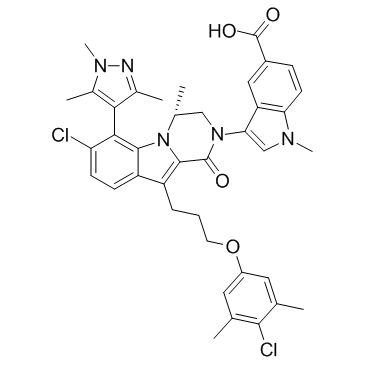
| DC12064 | VU0661013 Featured |
VU661013 is a potent and selective MCL-1 inhibitor.
More description
|
|
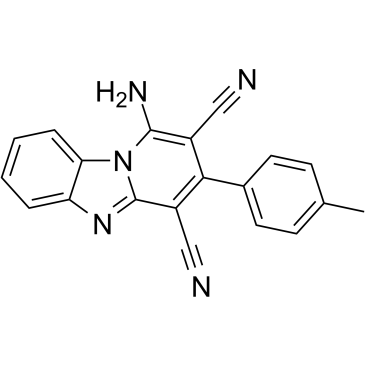
| DC39090 | iFSP1 Featured |
iFSP1 is a potent, selective and glutathione-independent inhibitor of ferroptosis suppressor protein 1 (FSP1/AIFM2) with EC50 of 103 nM. iFSP1 selectively induces ferroptosis in GPX4-knockout Pfa1 and HT1080 cells that overexpresses FSP1.
More description
|
|
| DC10389 | RIPA-56 Featured |
RIPA-56 is a highly potent, selective, and metabolically stable inhibitor of receptor-interacting protein 1 (RIP1) with an IC50 of 13 nM.
More description
|

|
| DC48694 | n-Octyl caffeate |
n-Octyl caffeate shows anti-cancer and apoptosis inducing activity in highly liver-metastatic murine colon 26-L5 carcinoma cell lines.
More description
|
|
| DC48643 | PDPOB |
PDPOB is a phenyl carboxylic acid derivative. PDPOB displays protective roles against OGD/R-evoked multiaspect neuronal deterioration in SH-SY5Y cells, as evidenced by alleviated mitochondrial dysfunction, oxidative stress, and apoptosis. PDPOB has the potential for the research of cerebral ischemia.
More description
|
|
| DC48621 | NS3694 |
NS3694, a diarylurea compound, is an apoptosome inhibitor. NS3694 inhibits apoptosome formation and caspase activation.
More description
|
|
| DC28336 | Se-Methylselenocysteine Featured |
Se-Methylselenocysteine, a precursor of Methylselenol, has potent cancer chemopreventive activity and anti-oxidant activity. Se-Methylselenocysteine is orally bioavailable, and induces apoptosis.
More description
|

|
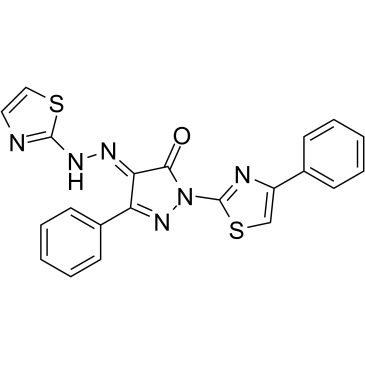
| DC28441 | BTSA1 Featured |
BTSA1 is a potent, high affinity and orally active BAX activator with an IC50 of 250 nM and an EC50 of 144 nM. BTSA1 binds with high affinity and specificity to the N-terminal activation site and induces conformational changes to BAX leading to BAX-mediat
More description
|
|
| DC10965 | SW076956 Featured |
SW076956 is a small molecule that selectively disrupt Beclin 1/Bcl-2 binding as compared to Bax/Bcl-2 and Bim/Bcl-2 binding and induces autophagic flux at concentrations with minimal cytotoxicity.
More description
|

|
| DC8599 | SP 141 Featured |
SP 141 is a cell-permeable inhibitor of Mdm2 (Ki = 28 nM).
More description
|
|
