 To enhance service speed and avoid tariff delays, we've opened a US warehouse. All US orders ship directly from our US facility.
| Cat. No. | Product Name | Field of Application | Chemical Structure |
|---|---|---|---|
| DC80225 | Antioxidant 245 |
Antioxidant 245 (AO-245) is a hindered phenol antioxidant. Antioxidant 245 can be used in the research of nanocomposites.
More description
|

|
| DC80194 | Amonafide L-malate |
Amonafide L-malate is a topoisomerase II inhibitor and DNA intercalator that induces Apoptotic signaling by blocking the binding of Topo II to DNA.
More description
|
|
| DC80170 | AK177 |
AK177 is an allosteric activator of IRE1α ribonuclease, with values of 480 nM and 180 nM against non-phosphorylated and phosphorylated IRE1α, respectively.\n
More description
|
|
| DC80159 | ADP receptor-IN-1 |
ADP receptor-IN-1 (compound 21) is a platelet ADP receptor inhibitor. ADP receptor-IN-1 shows both IC50 values <10 μM at a platelet ADP receptor binding assay and aggregation using a platelet-rich plasma assay.
More description
|
|
| DC80132 | 9-Deoxyforskolin |
9-Deoxyforskolin (compound 2) is a labdane-type diterpenoid, and also a forskolin derivative identified in hairy root cultures of Coleus forskohlii.
More description
|
|
| DC80128 | 8-Oxo-Δ9-THC |
8-Oxo-Δ9-THC is an oxygenated tetrahydrocannabinol that can be found in Cannabis sativa L. variety CHPF-01.
More description
|
|
| DC80111 | 5-Hydroxymethyl flucloxacillin |
5-Hydroxymethyl flucloxacillin is an active metabolite of Flucloxacillin. 5-Hydroxymethyl flucloxacillin exhibits antibacterial activity.
More description
|
|
| DC80109 | 5-HT7/5-HT2A receptor antagonist 1 |
5-HT7/5-HT2A receptor antagonist 1 is a high-affinity, orally active, brain-penetrant 5-HT7 and 5-HT2A receptor ligand having a pKi = 8.1 at both receptors. 5-HT7/5-HT2A receptor antagonist 1 behaves as an antagonist in an in vitro functional assay for 5-HT2A and as an inverse agonist in an in vitro functional assay for 5-HT7. 5-HT7/5-HT2A receptor antagonist 1 blockade of 5-Carboxamidotryptamine (5-CT) induced hypothermia in rats, and blockade of 2,5-dimethoxy-4-iodoamphetamine (DOI) induced head-twitches in mice. 5-HT7/5-HT2A receptor antagonist 1 occupied 5-HT2A receptor binding sites in the frontal cortex of the rat brain. 5-HT7/5-HT2A receptor antagonist 1 can be used for the study of Neurological diseases.
More description
|
|
| DC80083 | 4-Guanidinobutanal |
4-Guanidinobutanal is a nucleoside metabolite.
More description
|
|
| DC80081 | 4-DMA-3'-OH-Chalcone |
4-DMA-3'-OH-Chalcone (compound 24) is a synthetic chalcone derivative and selective cytotoxic agent.4-DMA-3'-OH-Chalcone reduces viability of endometriotic cells, while preserving or enhancing viability of eutopic endometrial cells.4-DMA-3'-OH-Chalcone can be used for the research of endometriosis.
More description
|
|
| DC80012 | 1-Olein-2-butyrin-3-palmitin |
1-Olein-2-butyrin-3-palmitin is an acylglycerol.
More description
|
|
| DC79989 | 1954U89 |
1954U89 is a potent, lipid-soluble and orally active inhibitor of dihydrofolate reductase (DHFR). 1954U89 exhibits anticancer activity.
More description
|
|
| DC79963 | 1,3-Linolenin-2-linolein |
1,3-Linolenin-2-linolein is an acylglycerol.
More description
|
|
| DC79951 | 1,2-Olein-3-acetyl |
1,2-Olein-3-acetyl is an acylglycerol.
More description
|
|
| DC79938 | 1-(2-(But-3-yn-1-yloxy)ethoxy)-6-chlorohexane |
1-(2-(But-3-yn-1-yloxy)ethoxy)-6-chlorohexane is a PROTAC linker that can be used in the synthesis of PROTACs.
More description
|
|
| DC79934 | (S,R,S,R)-AHPC-Me-CO-C7-N3 |
(S,R,S,R)-AHPC-Me-CO-C7-N3 is a synthesized E3 ligase ligand-linker conjugate that incorporates the (S,R,S,R)-AHPC-Me based VHL ligand and a linker used in PROTAC technology. (S,R,S,R)-AHPC-Me-CO-C7-N3 can be connected to the ligand for protein by a linker to form PROTAC EZH2 Degrader-28.
More description
|
|
| DC79920 | (rel)-PRT062607 |
(rel)-PRT062607 ((rel)-P505-15) is the relative configuration of PRT062607. PRT062607 is a highly selective inhibitor of Syk kinase, with an IC50 value of 1-2 nM, and is more than 80 times less potent against Fgr, Lyn, FAK, Pyk2, and Zap70.
More description
|
|
| DC79916 | (Rac)-GSK2973980A |
(Rac)-GSK2973980A (Compound 215) is a DGAT1 inhibitor with an IC50 of 1.8 nM for hDGAT1. (Rac)-GSK2973980A can be used for research on obesity and obesity-related diseases.
More description
|
|
| DC79883 | (25R)-3Alpha,7alpha-dihydroxy-5beta-cholestanoyl-CoA |
(25R)-3Alpha,7alpha-dihydroxy-5beta-cholestanoyl-CoA is a coenzyme A derivative.
More description
|
|
| DC79879 | (1R,9S)-Dxd |
(1R,9S)-Dxd is an isomer of (Dxd). (1R,9S)-Dxd is an ADC payload that can be used in the synthesis of ADCs (antibody-drug conjugates).
More description
|
|
| DC77912 | Org 6582 |
Org 6582 is a competitive, selective, and long-acting 5-HT (Ki = 89 nM) uptake inhibitor. Org 6582’s inhibitory effect on 5-HT uptake can last for more than 48 hours. Org 6582 can be used for research on depressive disorders.
More description
|
|
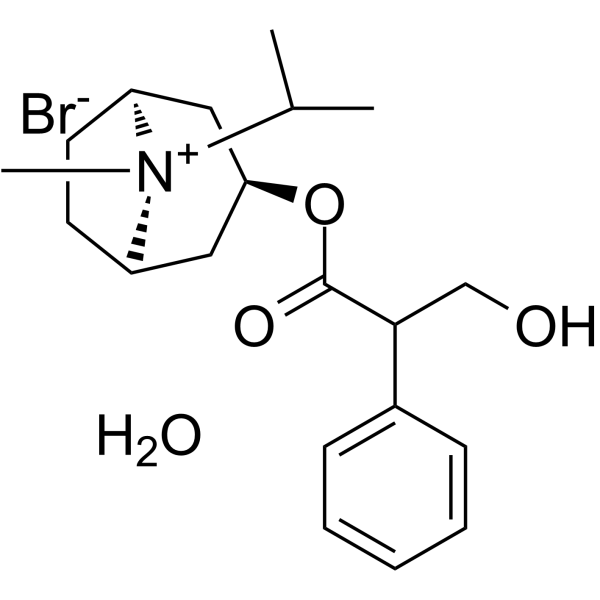
| DC44703 | Ipratropium bromide monohydrate Featured |
Ipratropium bromide (Atrovent, Sch 1000) monohydrate is an antagonist of muscarinic acetylcholine receptors (mAChR) with IC50 of 2.9 nM, 2.0 nM, and 1.7 nM for M1, M2, and M3 receptors, respectively.
More description
|
|
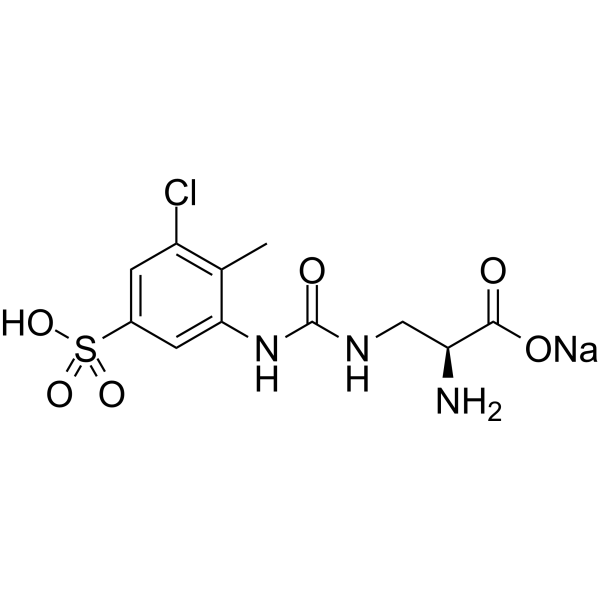
| DC48388 | Upacicalcet sodium Featured |
Upacicalcet (sodium) is an intravenous calcimimetic agent. Upacicalcet suppresses excessive parathyroid hormone (PTH) secretion, thereby lowering blood PTH levels, by acting directly on parathyroid cell membrane calcium-sensing receptors. Upacicalcet can be used for researching the disease of secondary hyperparathyroidism (SHPT).
More description
|
|
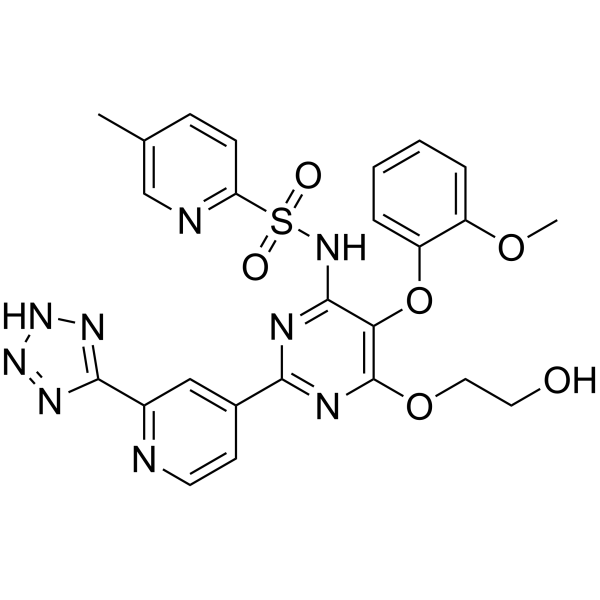
| DC72191 | Clazosentan Featured |
Clazosentan (Ro 61-1790) is a selective endothelin A (ETA) receptor antagonist. Clazosentan inhibits ET-1-mediated vasoconstriction. Clazosentan prevents cerebral vasospasm, vasospasm-related cerebral infarction.
More description
|
|
| DC78073 | MKP10241 Featured |
MKP10241 is an orally active GPR119 agonist. MKP10241 elevates cAMP levels in the GPR119 expressing cell line (EC50: 3.7 nM). MKP10241 reduces blood glucose levels and HbA1c in acute models and a chronic diabetic mouse model. MKP10241 also demonstrates excellent preclinical efficacy in acute as well as chronic rodent models of obesity, and MASH.
More description
|
|
| DC7991 | Clozapine N-oxide Featured |
Clozapine N-oxide is a major metabolite of Clozapine noted to decrease SR-2A (5-HT2 serotonin receptor) density in vitro.
More description
|

|
| DC79391 | T26A Featured |
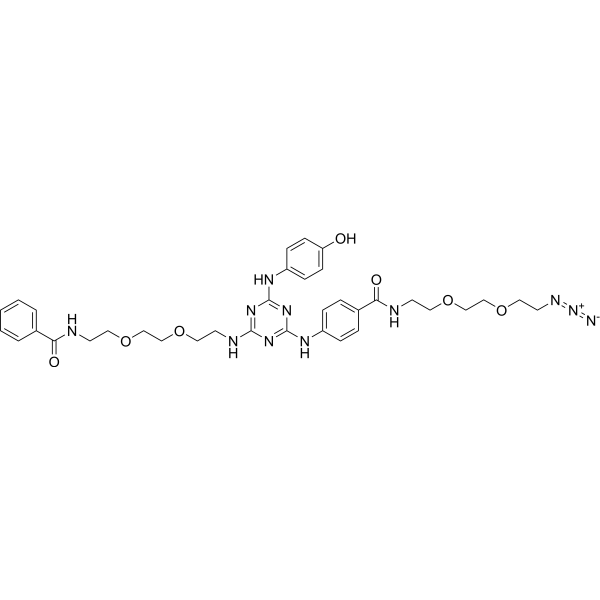
T26A is a competitive prostaglandin transporter (PGT) inhibitor (Ki=378 nM). T26A is promising for research of prostaglandin signaling and inflammatory diseases (e.g., glaucoma, pulmonary hypertension) .
More description
|
|
| DC70293 | CCR7 inhibitor Cmp1205 Featured |
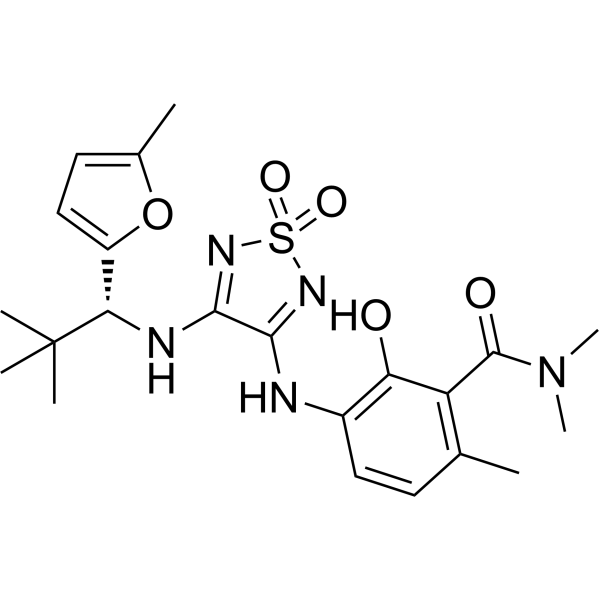
CCR7 inhibitor Cmp1205 is an allosteric ligand and antagonist for human CC chemokine receptor 7 (CCR7) with Kd of 3 nM, suppresses arrestin binding in response to activation by CCL19 with IC50 of 7.3 uM.Cmp1205 binds to a pocket at the intracellular part of CCR7 between the ends of TM1, TM2, TM3, and TM6 and the loop between TM7 and H8.Cmp1205 allosterically inhibits binding of the native chemokine CCL19 ligand in a membrane-based competition binding experiment with IC50 of 35 nM.
More description
|
|
| DC28432 | S26131 Featured |
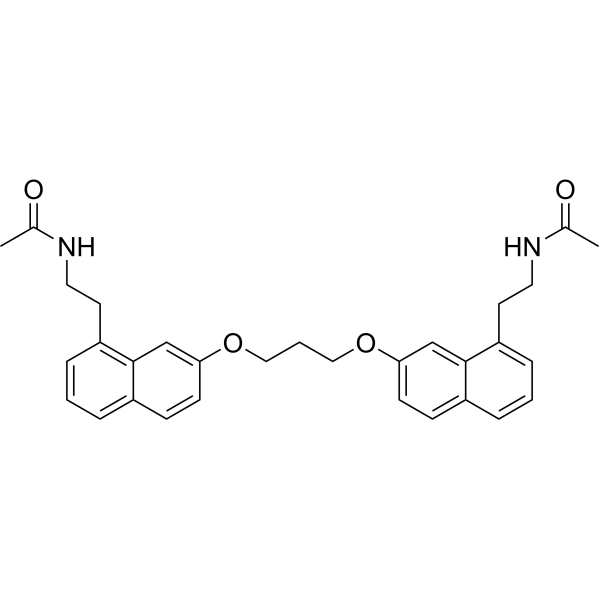
S26131 (compound 5) is a potent and selective MT1 melatoninergic ligand, and the Ki values are 0.5 and 112 nM for MT1 and MT2, respectively. S26131 behaves as an MT1 and MT2 antagonist.
More description
|
|
| DC10040 | Etrasimod(APD334) Featured |
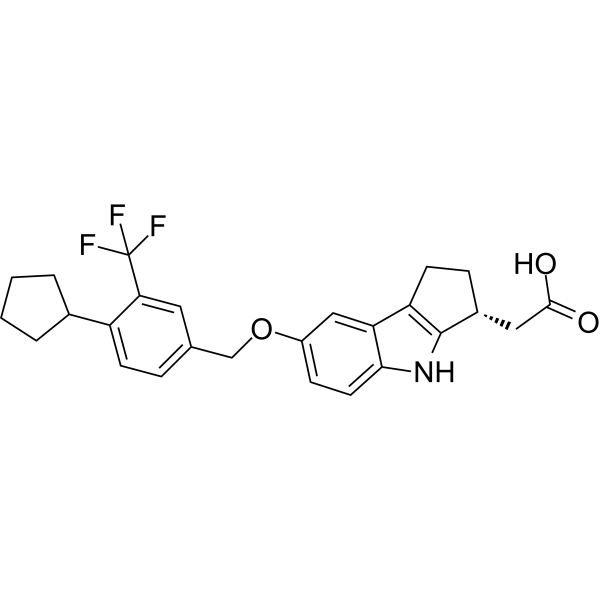
Etrasimod (APD334) is a potent, selective and orally available antagonist of the sphingosine-1-phosphate-1(S1P1) receptor with an IC50 value of 1.88 nM in CHO cells.
More description
|
|
