 To enhance service speed and avoid tariff delays, we've opened a US warehouse. All US orders ship directly from our US facility.
| Cat. No. | Product Name | Field of Application | Chemical Structure |
|---|---|---|---|
| DC41085 | 8-Hydroxy-DPAT hydrobromide Featured |
8-Hydroxy-DPAT hydrobromide (8-OH-DPAT hydrobromide) is a potent and selective 5-HT1A agonist with a pIC50 of 8.19. 8-Hydroxy-DPAT hydrobromide has selectivity of almost 1000 fold for a subtype of the 5-HT1 binding site.
More description
|

|
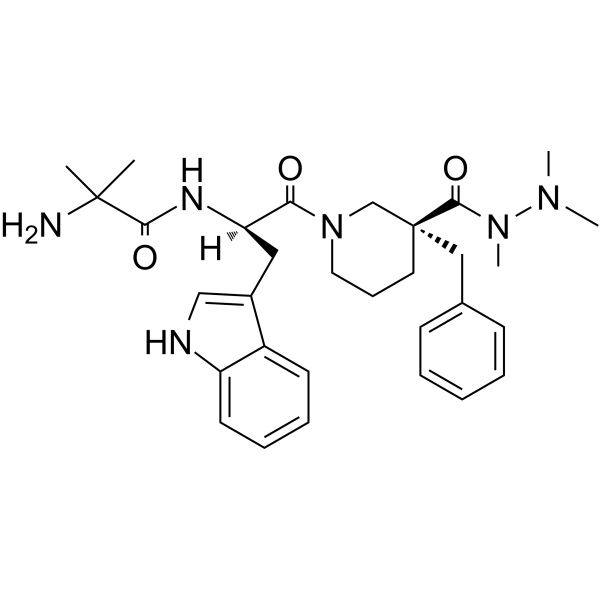
| DC7357 | Anamorelin Featured |
Anamorelin(RC1291; ONO-7643) is a synthetic orally active ghrelin receptor agonist which is under development for the management of non-small lung cancer associated cachexia/anorexia.
More description
|
|
| DC79862 | α-MSH (11-13) acetate |
α-MSH (11-13) acetate is the 11-13 amino acid (lysine-proline-valine) sequence of α-MSH, which reduces fever in rabbits.
More description
|

|
| DC79841 | MEN 10207 acetate |
MEN 10207 (acetate) is a selective antagonist of the NK-2 tachykinin receptor. MEN 10207 (acetate) induces tachykinin-induced contractions in rat bladder and guinea pig airways in vivo. MEN 10207 (acetate) inhibits [β-Ala 8 ]-NKA (4-10)-induced enhancement of bladder motility in anesthetized rats and [β-Ala 8 ]-NKA (4-10)-induced enhancement of bronchoconstriction in anesthetized guinea pigs.
More description
|
|
| DC79840 | XEN-2174 |
XEN-2174 is a noradrenaline transporter (NET) inhibitor. XEN-2174 inhibits the reuptake of noradrenaline through non-competitive inhibition, increasing the concentration of noradrenaline in the synaptic cleft, thereby activating α2-adrenergic receptor at the spinal level and exerting analgesic effects. XEN-2174 exhibits long-lasting analgesic effects in models of neuropathic pain and postoperative pain in rats. XEN-2174 can be used in pain research.
More description
|
|
| DC79836 | BPR-890 |
BPR-890 is a potent agonist of CB1. BPR-890 exhibits excellent CB2/1 selectivity and has in vivo efficacy in diet-induced obese mouse model.
More description
|
|
| DC79816 | pro-FTY |
pro-FTY, a FTY720 anticancer prodrug, is a sphingosine-1-phosphate (S1P) inhibitor. pro-FTY specifically inhibits S1P signaling in cancer cells using a drug delivery system (DDS) that reacts with acrolein. pro-FTY significantly inhibits the survival of breast cancer cells, including multidrug-resistant cells and its organoids resistant to Paclitaxel or Doxorubicin. pro-FTY potently suppresses tumor growth in 4T1 cells or organoids xenograft tumors mice model while avoiding lymphocytopenia.
More description
|
|
| DC79807 | RU-24213 hydrochloride |
RU-24213 hydrochloride is a selective D-2 dopamine receptor agonist. RU-24213 hydrochloride is also a KAPPA-opioid receptor antagonist. RU-24213 hydrochloride induces stereotyped behaviors.
More description
|
|
| DC79806 | 7-Hydroxy-DPAT |
7-Hydroxy-DPAT (7-OH-DPAT) is a selective D3 dopamine receptor agonist. 7-Hydroxy-DPAT exhibits significant pharmacological activity in modulating locomotor behavior and dopamine metabolism within the brain. 7-Hydroxy-DPAT can be used for the research of neurological disease .
More description
|
|
| DC79805 | TRK-851 |
RK-851 is a highly selective and orally active δ-opioid receptor antagonist, with a negative logarithm of the antagonist concentration (pA2) of 8.84. TRK-851 exhibits the selectivity for the δ receptor of more than 100 times higher than that for the μ or κ receptors. TRK-851 exhibits a potent antitussive effect in a rat model of capsaicin-induced cough. TRK-851 can be used for research on antitussive effects.
More description
|
|
| DC79798 | Vilanterol acetate |
Vilanterol (GW642444) acetate is a long-acting β2 adrenergic receptor agonist. Vilanterol acetate has pEC50 values for β2-AR, β1-AR, and β3-AR of 9.4, 6.4, and 6.1, respectively. Vilanterol acetate selectively activates airway β2 adrenergic receptors, increases cAMP and thus relaxes bronchial smooth muscle. Vilanterol acetate can be used in asthma research[1][2].
More description
|
|
| DC79797 | LM-189 |
LM-189, a G protein alpha subunit I (Gαi)-biased agonist, is a Gαi-biased ligand of β2-adrenergic receptor (β2AR). LM-189 stabilizes a distinct conformation in TM6 and increases the dynamics of ICL2. LM-189 can be used to develop the Gαi-biased β2AR agonists.
More description
|
|
| DC79796 | LM-189 free base |
LM-189 free base, a G protein alpha subunit I (Gαi)-biased agonist, is a Gαi-biased ligand of β2-adrenergic receptor (β2AR). LM-189 free base stabilizes a distinct conformation in TM6 and increases the dynamics of ICL2. LM-189 free base can be used to develop the Gαi-biased β2AR agonists.
More description
|
|
| DC79790 | CNV-dopamine |
CNV-dopamine is a photoreleasable D2 receptor-selective agonist. CNV-dopamine activates D2 receptors and induces G protein-coupled inwardly rectifying potassium (GIRK) currents. CNV-dopamine is promising for research of disorders like Parkinson’s disease and addiction.
More description
|
|
| DC79787 | 5-Hydroxy-6-methoxy (S)-duloxetine maleate |
5-Hydroxy-6-methoxy (S)-duloxetine maleate is an orally active and brain-penetrant serotonin (5-HT) and norepinephrine (NE) reuptake inhibitor with antidepressant and analgesic activities. 5-Hydroxy-6-methoxy (S)-duloxetine maleate is promising for research of psychiatric and neurological disorders such as depression, diabetic neuropathic pain, generalized anxiety disorder, and fibromyalgia.
More description
|
|
| DC79784 | Zelandopam anhydrous |
Zelandopam (anhydrous) (YM435 (anhydrous)) is an orally active and selective agonist of the dopamine D1 receptor. Zelandopam (anhydrous) possesses potent renal vasodilatory properties and can effectively alleviate Cisplatin-induced acute renal failure.
More description
|
|
| DC79783 | AM11542 |
AM11542 is a orthosteric agonist of cannabinoid receptor 1 (CB1), with a reported binding affinity (Ki) of 0.11 nM. AM11542 can be used for the study of CB1 receptor activation and related allosteric modulation mechanisms.
More description
|
|
| DC79768 | MRS2690 disodium |
MRS2690 disodium is a selective P2Y14 receptor agonist. MRS2690 disodium inhibits adenylyl cyclase activity, thereby reducing intracellular cAMP levels and mediating concentration-dependent vasoconstriction of porcine coronary arteries. MRS2690 disodium induces intracellular calcium mobilization, activates P38 and stimulates [35S]GTPγS binding to RBL-2H3 cell membranes. MRS2690 enhances antigen (NP-BSA)-, C3a-induced β-hexosaminidase (β-Hex) release. MRS2690 disodium can be used for ischemic heart disease.
More description
|
|
| DC79761 | K-833 |
K-833 is a GPR119 agonist with EC50 values of 39.8 nM (human), 100nM (mouse), 75.4 nM (rat) and 12.6 nM (dog). K-833 demonstrates a modest increase in GLP-1 secretion and leads to a synergistic increase in GLP-1 levels when combined with AM-5262 in acute gut peptide secretion assays in mice. K-833 can be used in studies on weight loss.
More description
|
|
| DC79760 | CI-988 meglumin |
CI-988 (meglumin) is a cholecystokinin 2 receptor (CCK2R) antagonist. CI-988 (meglumin) prevents the gastrin-mediated protection of the heart with ischemia/reperfusion injury.
More description
|
|
| DC79757 | TKS 159 |
TKS 159 is a 5-HT4 receptor agonist. TKS 159 can promote gastrointestinal motility. TKS 159 can be used for research on gastrointestinal conditions.
More description
|
|
| DC79750 | MDL 43291 |
MDL 43291 is a competitive leukotriene (LT) receptor antagonist. MDL 43291 antagonize LTD4 and LTE4 with pA2 of 6.7. MDL 43291 does not antagonize histamine, carbachol or substance P. MDL 43291 can be used for the researches of inflammation and immunology, such as asthma.
More description
|
|
| DC79735 | PD 121981 |
PD 121981 is a angiotensin II receptor antagonist. PD 121981 can be used for the research of cardiovascular disease.
More description
|
|
| DC79731 | VUF26034 |
VUF26034 (Compound 12b) is a photoresponsive ligand for the human β2-adrenergic receptor (β2-AR.
More description
|
|
| DC79728 | S-1255 |
S-1255 is an orally active and highly selective endothelin ETA receptor antagonist (Kd=0.39 nM). S-1255 blocks vasoconstriction and sustains hypotensive effects in hypertensive rats. S-1255 is promising for research of hypertension and cardiovascular disorders.
More description
|
|
| DC79724 | TGI-15 |
TGI-15 is a highly selective prostaglandin F receptor antagonist. TGI-15 inhibits downstream signaling pathways by blocking the binding of PGF2 α to FP receptors. TGI-15 can be used for research on fibrotic and inflammatory conditions.
More description
|
|
| DC79723 | BMT-136088 |
BMT-136088 is a radioligand used for positron emission tomography (PET) imaging of idiopathic pulmonary fibrosis.
More description
|
|
| DC79717 | CGP 57698 |
CGP 57698 is an efficient CysLT receptor (Ki = 5.7 nM) antagonist. CGP 57698 can effectively counteract bronchoconstriction caused by LTD4. CGP 57698 can be used for research on asthma or allergic conditions.
More description
|
|
| DC79709 | LY459477 |
LY459477 is a potent, selective and orally active metabotropic glutamate 2/3 receptor (mGluR2/3) agonist. LY459477 can effectively suppress Phencyclidine-evoked locomotor activity at doses that do not impair neuromuscular coordination. LY459477 can be used for the research of neurological disease.
More description
|
|
| DC79692 | LMD-902 |
LMD-902, a LMD-009) analog, is a CCR8 agonist with an EC50 of 15 nM. LMD-902 has a superior binging capacity depending on key residues such as PheVI:16. LMD-902 can be used for inflammation diseases like bronchial asthma and central nervous system diseases like multiple sclerosis research.
More description
|
|
