 To enhance service speed and avoid tariff delays, we've opened a US warehouse. All US orders ship directly from our US facility.
| Cat. No. | Product Name | Field of Application | Chemical Structure |
|---|---|---|---|
| DC80076 | 447C88 |
447C88 is an acyl-coenzyme A cholesterol acyltransferase (ACAT) inhibitor with an IC50 of 23 nM. 447C88 can reduce plasma cholesterol levels and can be used in the research of endocrine and metabolic diseases such as hyperlipidemia.
More description
|

|
| DC80074 | 4-(2-Boc-aminoethyl)piperidine |
4-(2-Boc-aminoethyl)piperidine is a PROTAC linker that can be used in the synthesis of PROTACs.
More description
|
|
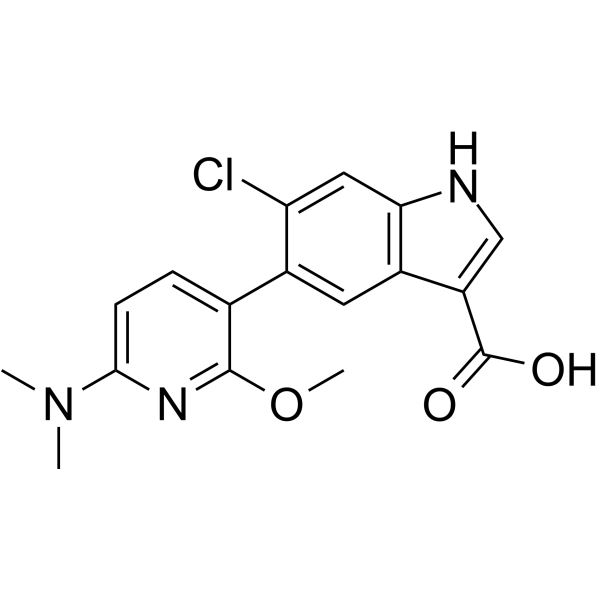
| DC80099 | 5-C-phenethyl-DNJ |
5-C-phenethyl-DNJ is a selective α-glucosidase GAA inhibitor, with its Ki value for rhGAA being 0.81 μM. 5-C-phenethyl-DNJ exhibits extremely high selectivity for GANAB, GBA1, and GBA2. 5-C-phenethyl-DNJ can be used for the study of Pompe disease.
More description
|
|
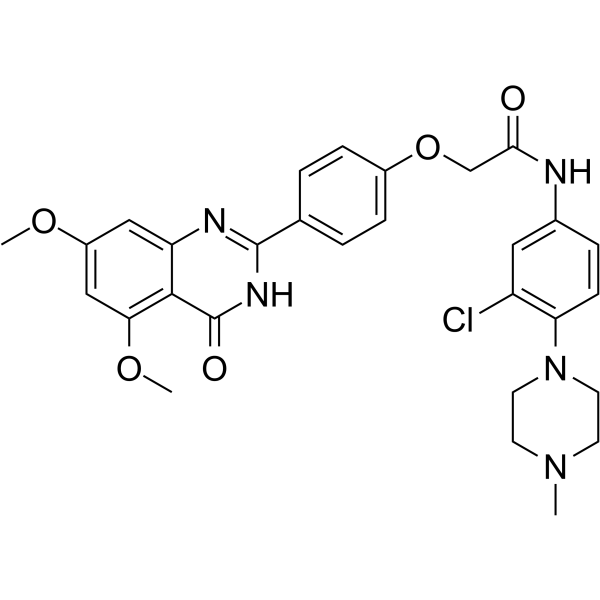
| DC80106 | 5-HT2C agonist-13 |
5-HT2C agonist-13 is an orally active, selective and brain-penetrant 5-HT2C receptor agonist with human 5-HT2C receptor EC50 of 16 nM, Ki of 20 nM. 5-HT2C agonist-13 functionally activates 5-HT2C receptors, reduces food intake, reduces body weight gain, and exhibits effects reversible by a selective 5-HT2C antagonist. 5-HT2C agonist-13 can be used for the research of obesity.
More description
|
|
| DC80088 | 4-Methoxyisophthalic acid |
4-Methoxyisophthalic acid (4-Methoxy-1,3-benzenedicarboxylic acid) is a metal-organic framework (MOF).
More description
|

|
| DC80075 | 41-O-Demethylrapamycin |
41-O-Demethylrapamycin is a metabolite of Rapamycin produced by Bacillus megaterium.
More description
|

|
| DC80073 | 3α,7α-Dihydroxycoprostane |
3α,7α-Dihydroxycoprostane is a metabolite of cholest-4-en-3-one-7α-ol.
More description
|

|
| DC80080 | 4-Demethoxy-7,9-di-epi-daunorubicin |
4-Demethoxy-7,9-di-epi-daunorubicin, a derivative of Daunorubicin, is an anthracycline antibiotics. 4-Demethoxy-7,9-di-epi-daunorubicin can bind to calf thymus DNA and forms a complex with the stacked DNA base pairs. 4-Demethoxy-7,9-di-epi-daunorubicin can inhibit prokaryotic nucleic acid polymerases, including E. coli DNA polymerase I and RNA polymerase. 4-Demethoxy-7,9-di-epi-daunorubicin can be used for researches of cancer and infection.
More description
|
|
| DC80072 | 3α,7α-Dihydroxy-5β-cholestan-26-al |
3α,7α-Dihydroxy-5β-cholestan-26-al is a nucleoside metabolite.
More description
|
|
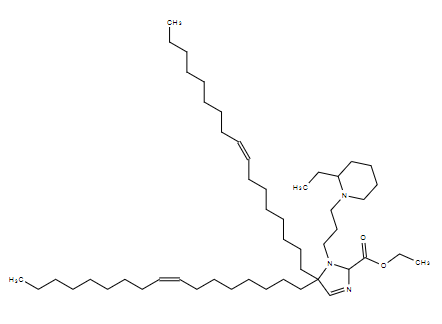
| DC80071 | 3tBu-Crown TFA |
3tBu-Crown TFA is a chelator. 3tBu-Crown TFA chelates radiometals and couples to biological targeting moieties to facilitate targeted delivery of chelated radiometals.3tBu-Crown TFA can be used for the research of cancer.
More description
|
|
| DC80070 | 3-Phospho-D-glycerate |
3-Phospho-D-glycerate can be converted to 2-phospho-d-glycerate (2-PGA) via phosphoglycerate mutase.
More description
|

|
| DC80067 | 3'-O-(2-Nitrobenzyl)-dCTP |
3'-O-(2-Nitrobenzyl)-dCTP is a reversible terminator. 3'-O-(2-Nitrobenzyl)-dCTP can be recognized and incorporated by polymerases, thereby temporarily terminating primer extension during DNA synthesis. After incorporation into the extending DNA strand, 3'-O-(2-Nitrobenzyl)-dCTP temporarily halts the DNA polymerase extension reaction, and its 3'-O-(2-nitrobenzyl) blocking group can be removed by laser irradiation to regenerate a free 3'-OH for subsequent primer extension cycles. 3'-O-(2-Nitrobenzyl)-dCTP is applicable for resolving homopolymeric regions in DNA templates.
More description
|
|
| DC80064 | 3-Methylcathinone hydrochloride |
3-Methylcathinone (3-MMC) hydrochloride is an analogue of a psychoactive substance.
More description
|
|
| DC80063 | 3'-Methoxy-4'-nitroflavone |
3'-Methoxy-4'-nitroflavone (MNF) is a specific aryl hydrocarbon receptor (AhR) antagonist. 3'-Methoxy-4'-nitroflavone activates AhR by inhibiting CYP1, the metabolic enzyme of the endogenous ligand FICZ, leading to the accumulation of FICZ. 3'-Methoxy-4'-nitroflavone reverses the anti-apoptotic effect of TCDD, attenuates the activation of Akt and Erk1/2 kinases and the expression of TGFα induced by TCDD. 3'-Methoxy-4'-nitroflavone can be used in research related to breast tumor promotion, rheumatoid arthritis, multiple sclerosis and inflammatory bowel disease.
More description
|
|
| DC80062 | 3'-Fluorothymidine-5'-triphosphate (tetrasodium) |
3'-Fluorothymidine-5'-triphosphate tetrasodium (3'-FdTTP tetrasodium) is a dTTP analog. 3'-Fluorothymidine-5'-triphosphate tetrasodium inhibits the T4 DNA polymerases competitively with dTTP. 3'-Fluorothymidine-5'-triphosphate tetrasodium inhibits DNA synthesis by T4 wild-type, L98 and CB121 DNA polymerase.
More description
|
|
| DC80061 | 3''-Deamino-3''-hydroxykanamycin B |
3''-Deamino-3''-hydroxykanamycin B (NK-1012-1) is a kanamycin antibiotic. 3''-Deamino-3''-hydroxykanamycin B can be produced by S. tenebrarius. 3''-Deamino-3''-hydroxykanamycin B is effective against E. coli ATCC 25922 and E. coli CCARM 1A020, with MIC values of 128 μg/mL.
More description
|
|
| DC80059 | 3-Boc-aminomethylazetidine |
3-Boc-aminomethylazetidine is a PROTAC linker that can be used in the synthesis of PROTACs.
More description
|
|
| DC80058 | 3-Boc-3,9-Diazaspiro[5.5]undecane hydrochloride |
3-Boc-3,9-Diazaspiro[5.5]undecane (hydrochloride) is a PROTAC linker that can be used in the synthesis of PROTACs.
More description
|
|
| DC80057 | 3-Benzylmalic acid |
3-Benzylmalic acid (3-Benzylmalate) can be converted from 2-Benzylmalic acid through a HphCD-mediated hydroxyl isomerization reaction.
More description
|
|
| DC80056 | 3-Benzyl-3,9-diazaspiro[5.5]undecane |
3-Benzyl-3,9-diazaspiro[5.5]undecane is a PROTAC linker that can be used in the synthesis of PROTACs.
More description
|
|
| DC80055 | 3-Amino-5-hydroxybenzoic acid-13C |
3-Amino-5-hydroxybenzoic acid-13C is the 13C-labeled 3-Amino-5-hydroxybenzoic acid. 3-Amino-5-hydroxybenzoic acid is a biosynthetic precursor of the mC7N unit of ansamycin antibiotics, including ansatrienin A and geldanamycin, as well as the antitumor antibiotic mitomycin C. 3-Amino-5-hydroxybenzoic acid may be an early intermediate in the shikimic acid pathway from glucose.
More description
|
|
| DC80054 | 349U85 hydrochloride |
349U85 hydrochloride is a vasodilator-cardiotonic agent.
More description
|
|
| DC80053 | 3-[4-(2-Propyn-1-yloxy)phenyl]-2H-azirine |
3-[4-(2-Propyn-1-yloxy)phenyl]-2H-azirine (Compound AZ-9) is a reactive probe based on 3-phenyl-2H-azirine, enabling chemoselective bioconjugation of carboxyl residues in proteins with excellent labeling efficiency and specificity under both in vitro and in situ conditions in live cells.
More description
|
|
| DC80051 | 3-(4-Carboxyphenyl)propanoic acid |
3-(4-Carboxyphenyl)propanoic acid is a PROTAC linker that can be used in the synthesis of PROTACs.
More description
|
|
| DC80049 | 3-(4-Bromobenzoyl)propionic acid |
3-(4-Bromobenzoyl)propionic acid is a PROTAC linker that can be used in the synthesis of PROTACs.
More description
|
|
| DC80048 | 2α-Ferrocenylmethyl-DHT |
2α-Ferrocenylmethyl-DHT is a dihydrotestosterone-derived ferrocene-steroid conjugate. 2α-Ferrocenylmethyl-DHT inhibits the growth of various cancer cells. 2α-Ferrocenylmethyl-DHT induces S-phase cell cycle arrest in ovarian cancer cells, elevates intracellular iron levels, triggers ROS-dependent cell death, and disrupts the integrity of multicellular tumor spheroids of ovarian cancer cells. 2α-Ferrocenylmethyl-DHT can be used in the research of prostate cancer and ovarian cancer.
More description
|
|
| DC80047 | 2-Tetralone |
2-Tetralone (Beta-Tetralone) is a pro-apoptosis agent. 2-Tetralone targets MDM2 E3 ubiquitin kinase and Bcl-w anti-apoptotic protein and exhibits anticancer activity.
More description
|
|
| DC80046 | 2-Oxo-(4R)-hydroxy-5-aminovaleric acid |
2-Oxo-(4R)-hydroxy-5-aminovaleric acid is a nucleoside metabolite.
More description
|
|
| DC80045 | 2'-Nitroflavone |
2'-Nitroflavone is a PARP1 inhibitor. 2'-Nitroflavone inhibits the proliferation, induces cell cycle arrest and apoptosis of triple-negative breast cancer cells. 2'-Nitroflavone also inhibits the migration of triple-negative breast cancer cells and endothelial cells. 2'-Nitroflavone exhibits antitumor activity and can be used in the research of tumors such as triple-negative breast cancer.
More description
|
|
| DC80044 | 2-MSP-5-HA-VC-PAB-MMAE |
2-MSP-5-HA-VC-PAB-MMAE (Compound B-1) is a Drug-Linker Conjugates for ADC. 2-MSP-5-HA-VC-PAB-MMAE consists of the ADC Cytotoxin Monomethyl auristatin E and a linker 2-MSP-5-HA-VC-PAB-OH. 2-MSP-5-HA-VC-PAB-MMAE can be used for synthesis of ADCs.
More description
|
|
