 To enhance service speed and avoid tariff delays, we've opened a US warehouse. All US orders ship directly from our US facility.
| Cat. No. | Product Name | Field of Application | Chemical Structure |
|---|---|---|---|
| DC48111 | Antitumor agent-37 |
Antitumor agent-37 possesses potent anti-proliferative and anti-metastasis activities. Antitumor agent-37 induces serious DNA damage and further leads to high expression of γ-H2AX and p53. Antitumor agent-37 promotes apoptosis of tumor cells through mitochondrial apoptotic pathway Bcl-2/Bax/caspase3. Antitumor agent-37 significantly improves immune response through restraining the expression of PD-L1 to increase CD3+ and CD8+ T infiltrating cells in tumor tissues.
More description
|

|
| DC48110 | S-Allylmercaptocysteine |
S-allylmercaptocysteine, an organic sulfur compound extracted from garlic, has anti-inflammatory and anti-oxidative effects for various pulmonary diseases. S-allylmercaptocysteine achieves its anti-cancer effect through a variety of pathways such as inducing the apoptosis of cancer cells through the TGF-β signaling pathway, or reducing the NF-κB activity and up-regulating Nrf2 to achieve the effects of anti-inflammation and anti-oxidation.
More description
|
|
| DC48109 | Verrucarin J |
Verrucarin J (Muconomycin B) is a metabolite of the Myrothecium fungus family. Verrucarin J generates reactive oxygen species (ROS) and induces apoptosis of cancer cell lines, such as A549, HCT 116 and SW-620 cells. Verrucarin J shows activities against Candida albicans and Mucor miehei. Verrucarin J inhibits arenavirus Junin (JUNV) yield with an IC50 of 1.2 ng/mL.
More description
|
|
| DC48108 | Antitumor agent-36 |
Antitumor agent-36 possesses potent anti-proliferative and anti-metastasis activities. Antitumor agent-36 induces serious DNA damage and further leads to high expression of γ-H2AX and p53. Antitumor agent-36 promotes apoptosis of tumor cells through mitochondrial apoptotic pathway Bcl-2/Bax/caspase3. Antitumor agent-36 significantly improves immune response through restraining the expression of PD-L1 to increase CD3+ and CD8+ T infiltrating cells in tumor tissues.
More description
|
|
| DC48106 | MERS-CoV-IN-1 |
MERS-CoV-IN-1 exhibits excellent inhibitory activity against coronavirus. MERS-CoV-IN-1 is useful as a pharmaceutical composition for preventing coronavirus-induced diseases (MERS-CoV and SARS) (extracted from patent WO2018174442A1, compound 1).
More description
|
|
| DC48105 | Antiviral agent 5 |
Antiviral agent 5 is an intermediate used in antiviral agents targeting 3C and 3CL proteases including SARS-CoV-2 Mpro.
More description
|
|
| DC48104 | RSV-IN-2 |
RSV-IN-2 is a potent dual inhibitor of wild-type and mutant respiratory syncytial virus fusion proteins (wild-type, EC50 = 0.27 nM; D486N-mutant, EC50 = 0.70 nM).
More description
|
|
| DC48103 | Onradivir |
Onradivir is a significantly better anti-influenza virus agent extracted from patent WO2021047437 A1.
More description
|
|
| DC48102 | Claficapavir |
Claficapavir (A1752) is a specific nucleocapsid protein (NC) inhibitor with an IC50 around 1 μM. Claficapavir strongly binds the HIV-1 NC (Kd=20 nM) thereby inhibiting the chaperone properties of NC and leading to good antiviral activity against the HIV-1.
More description
|
|
| DC48101 | Amphotericin B methyl ester hydrochloride |
Amphotericin B methyl ester hydrochloride is the methyl ester derivative of the polyene antibiotic Amphotericin B (A634250). Amphotericin B methyl ester hydrochloride is the cholesterol-binding compound possesses significant antifungal activity. Amphotericin B methyl ester hydrochloride disrupts HIV-1 particle production and potently inhibits HIV-1 replication.
More description
|
|
| DC48100 | Decanoyl-RVKR-CMK TFA |
Decanoyl-RVKR-CMK (DecRVKRcmk) TFA inhibits over-expressed gp160 processing and HIV-1 replication.
More description
|
|
| DC48098 | HIV-1 inhibitor-10 |
HIV-1 inhibitor-10 is a nanomolar HIV-1 maturation inhibitor.
More description
|
|
| DC48097 | ASP5286 |
ASP5286 is a novel non-immunosuppressive cyclophilin inhibitor for the treatment of HCV.
More description
|
|
| DC48096 | Ajoene |
Ajoene, a garlic-derived compound, is an antithrombotic and antifungal agent. Ajoene inhibits proliferation and induces apoptosis of human leukaemia CD34-negative cells including HL-60, U937, HEL and OCIM-I. Anticancer activities.
More description
|
|
| DC48095 | Eberconazole |
Eberconazole is a dichlorinated imidazole derivative with antifungal activity. Eberconazole is more active than Clotrimazole, Ketoconazole, and Miconazole. Eberconazole has the potential for the research of dermatophytoses with a topical administration.
More description
|
|
| DC48094 | Flutrimazole |
Flutrimazole is an imidazole antifungal with dual anti-inflammatory and antifungal activity. Flutrimazole shows scarce transdermal penetration. Flutrimazole has the advantageous in the research of topical fungal infections with an inflammatory component.
More description
|
|
| DC48093 | Voxvoganan |
Voxvoganan is a potent fungicide that disturbs plasma membrane integrity in a sphingolipid dependent manner.
More description
|
|
| DC48092 | AN0128 |
AN0128 is a boron-containing antibacterial and anti-inflammatory agent. AN0128 against S. aureus, S. epidermidis, P. acnes, B. subtilis with minimum inhibitory concentration (MIC) values of 1, 0.5, 0.3, 1 μg/mL. AN0128 can be used for the research of periodontal disease and cutaneous diseases.
More description
|
|
| DC48091 | Cadrofloxacin |
Cadrofloxacin (Caderofloxacin; CS-940), a orally active fluoroquinolone, is effective against aerobic/anaerobic Gram-positive and Gram-negative bacteria. Cadrofloxacin can be used for the research of infectious diseases.
More description
|
|
| DC48090 | Cefditoren sodium |
Cefditoren sodium (ME 1206) is a broad-spectrum, third-generation, oral cephalosporin antibacterial with enhanced stability against many common β lactamases. Cefditoren sodium has activity against Gram-negative organisms and Gram-positive organisms. Cefditoren sodium can be used in the research of infection diseases such as acute exacerbations of chronic bronchitis, community-acquired pneumonia (CAP), streptococcal pharyngitis/tonsillitis, or uncomplicated skin and skin structure infections.
More description
|
|
| DC48089 | Aditoprime |
Aditoprime (Aditoprim), a selective bacterial dihydrofolate reductase (DHFR) inhibitor, inhibits the transformation of dihydrofolic acid to tetrahydrofolic acid. Aditoprime inhibits E.coli and L.casei DHFR with IC50 of 47 and 520 nM, respectively. Aditoprime has a broad antimicrobial spectrum, good antibacterial activity and excellent pharmacokinetics.
More description
|
|
| DC48088 | Sulfamethomidine |
Sulfamethomidine is an antibacterial agent.
More description
|
|
| DC48087 | TP0586352 |
TP0586352 is a LpxC inhibitor that is effective against carbapenem-resistant Klebsiella pneumoniae and does not pose a cardiovascular risk.
More description
|
|
| DC48086 | N-3-oxo-dodecanoyl-L-homoserine lactone |
N-3-oxo-dodecanoyl-L-Homoserine lactone (3-oxo-C12-HSL) is a bacterial quorum-sensing signaling molecule produced by P. aeruginosa and strains of the B. cepacia complex.Quorum sensing is a regulatory system used by bacteria for controlling gene expression in response to increasing cell density.N-3-oxo-dodecanoyl-L-Homoserine lactone induces the production of IL-8 in 16HBE human bronchial epithelial cells.
More description
|
|
| DC48085 | Sirpefenicol |
Sirpefenicol is a phenicol antibacterial agent. Sirpefenicol can be used in bacterial infections in animals (extracted from patent WO2020068607A1).
More description
|
|
| DC48084 | EGCG Octaacetate |
EGCG Octaacetate (AcEGCG) is a prodrug of Green tea epigallocatechin-3-gallate (EGCG). EGCG Octaacetate decreases the proinflammatory mediator levels by down-regulating of PI3K/Akt/NFκB phosphorylation and p65 acetylation. EGCG Octaacetate reduces colitis-driven colon cancer in mice. EGCG octaacetate is the potential antibacterial compound for gram-positive bacteria (GPB) and gram-negative bacteria (GNB).
More description
|
|
| DC48083 | N-Hexanoyl-DL-homoserine lactone |
N-Hexanoyl-DL-homoserine lactone is a bacterial quorum sensing molecule produced in the rhizosphere. N-Hexanoyl-DL-homoserine lactone, a bacterial quorum sensing signal, induces transcriptional changes in Arabidopsis and may contribute to tuning plant growth to the microbial composition of the rhizosphere.
More description
|
|
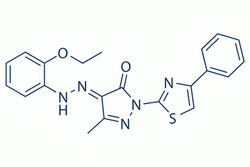
| DC7080 | BAM 7 Featured |
BAM 7 is a direct and selective activator of proapoptotic Bax with EC50 of 3.3 μM.
More description
|
|
| DC23979 | BAMB-4(ITPKA-IN-C14) Featured |
A specific and membrane-permeable inhibitor of the InsP3Kinase activity of ITPKA (inositol-1,4,5-trisphosphate-3-kinase A) with IC50 of 20 uM.
More description
|

|
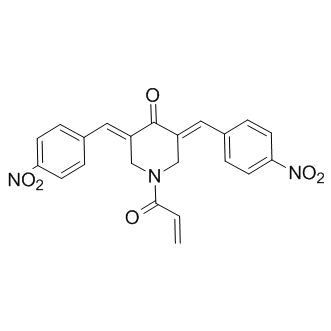
| DC8203 | b-AP15(NSC687852) Featured |
b-AP15(NSC687852) is a specific inhibitor of the deubiquitinating enzymes UCHL5 and Usp14 of the 26S proteasome. It blocks the deubiquitinating activity of the 26S proteasome.
More description
|
|
