 To enhance service speed and avoid tariff delays, we've opened a US warehouse. All US orders ship directly from our US facility.
| Cat. No. | Product Name | Field of Application | Chemical Structure |
|---|---|---|---|
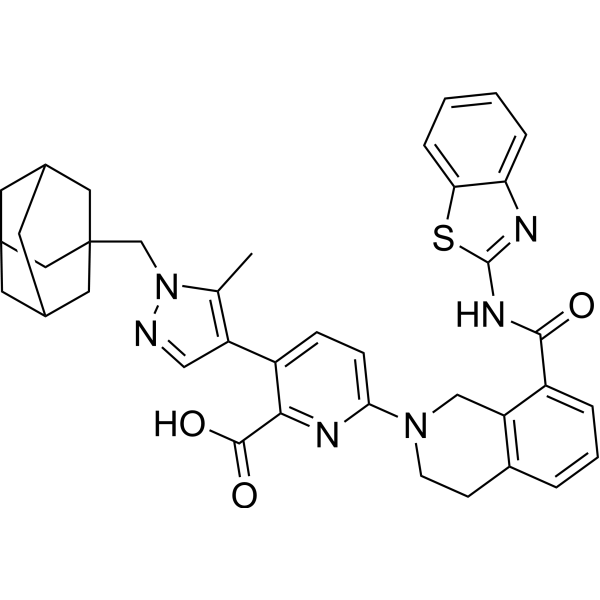
| DC80532 | DHX9-IN-18 |
DHX9-IN-13 (Example 1) is a RNA helicase DHX9 inhibitor with an EC50 of 16.4 μM. DHX9-IN-13 exhibits biochemical infection point of 0.32 μM. DHX9-IN-13 can be used for the study of cancers.
More description
|

|
| DC80529 | DHFR-IN-24 |
DHFR-IN-24, a benzothiazole derivative, is a dihydrofolate reductase (DHFR) inhibitor. DHFR-IN-24 has intrinsic antibacterial activity against both Gram-positive and Gram-negative strains. DHFR-IN-24 synergistically combines DHFR inhibition with photodynamic therapy (PDT) for enhanced antibacterial activity against multidrug-resistant pathogens.
More description
|
|
| DC80498 | CXL 017 |
CXL 017 is a sarco/endoplasmic reticulum Ca2+-ATPase (SERCA) inhibitor. CXL 017 can inhibit the ATPase activity of SERCA by competing with ATP for binding. CXL 017 exhibits selective cytotoxicity against multidrug-resistant acute myeloid leukemia cells HL60/MX2. CXL 017 can be used in the research of tumors such as multidrug-resistant acute myeloid leukemia.
More description
|
|
| DC80492 | CTR/AMYR modulator-2 |
CTR/AMYR modulator-2 (Example 107) is a receptor 3 for pancreatic amyloid peptide (bAMY3R) agonist, and its EC50 for stimulating cAMP production in cells is <500 nM. CTR/AMYR modulator-2 is also a receptor for calcitonin (bCTR) agonist, with its EC50 being <5000 nM. CTR/AMYR modulator-2 can be used for research on type 2 diabetes and obesity.
More description
|
|
| DC80482 | CPU-228 |
CPU-228 is a complex class III antiarrhythmic agent. CPU-228 concentration-dependently blocks the activities of the rapid component 50 of the delayed rectifier potassium channel (IKr) and the L-type calcium channel (ICa,L), with an IC50 value of 0.909 μM for ICa,L current. CPU-228 produces negative inotropic effects and induces mild, non-frequency-dependent prolongation of the effective refractory period (ERP) in isolated left atria. CPU-228 reduces the incidence of torsades de pointes (TDP) in anesthetized rabbits and inhibits ischemia/reperfusion-induced arrhythmias in rats. CPU-228 can be used in studies related to torsades de pointes.
More description
|
|
| DC80270 | Atg4B activator-1 |
Atg4B activator-1 (Compound 16a) is an allosteric, selective, and orally active ATG4B activator with a Kd of 0.2199 μM. Atg4B activator-1 binds to the allosteric pocket of ATG4B and induces conformational changes. Atg4B activator-1 induces Autophagy. Atg4B activator-1 inhibits the proliferation and migration of triple-negative breast cancer cells. Atg4B activator-1 can be used in studies related to triple-negative breast cancer.
More description
|
|
| DC80252 | AR-102 free acid |
AR-102 free acid, an active metabolite of AR-102, is a prostaglandin F (PGF) derivative.
More description
|
|
| DC80221 | Antimicrobial agent-46 |
Antimicrobial agent-46 is a inhibitor of Salmonella typhimurium serine acetyltransferase (StSAT) with an IC50 of 48.6 μM. Antimicrobial agent-46 inhibits bacterial growth in minimal medium lacking cysteine (LB 20%). Antimicrobial agent-46 exerts its effect by targeting the cysteine biosynthesis pathway, which is crucial for bacterial persistence and adaptability. Antimicrobial agent-46 exhibits antibacterial activity against the Gram-negative bacterium Escherichia coli. Antimicrobial agent-46 can be used in infection-related research .
More description
|
|
| DC80188 | AM-112 |
AM-112 is a β-lactamase (β-lactamase) inhibitor and antibacterial agent, with IC50 values ranging from 0.0002 μg/mL to 0.67 μg/mL against class A, C, and D β-lactamase. By inhibiting PBP2, the penicillin-binding protein of E. coli, and protecting Ceftazidime from enzymatic hydrolysis, AM-112 significantly enhances the antibacterial efficacy of Ceftazidime against Gram-negative bacteria, enterococci, and staphylococci. AM-112 exhibits favorable pharmacokinetic properties and acid-base stability. AM-112 can be used for the research of bacterial infections.
More description
|
|
| DC80164 | AGN 192403 |
AGN 192403 (BRD4780) is a potent and selective imidazoline-1 receptor antagonist with a Ki value of 42 nM. AGN 192403 is also a TMED9 inhibitor. AGN 192403 shows protective effects on oxidative cytotoxicity and mitochondrial inhibitor-induced cytotoxicity in astrocytes. AGN 192403 mitigates the proliferation and migration of differentiated glioma tumor cells. AGN 192403 can be used for glioma tumor and neurological diseases research.
More description
|
|
| DC80056 | 3-Benzyl-3,9-diazaspiro[5.5]undecane |
3-Benzyl-3,9-diazaspiro[5.5]undecane is a PROTAC linker that can be used in the synthesis of PROTACs.
More description
|
|
| DC79912 | (R,R)-Birelentinib |
(R,R)-Birelentinib ((R,R)-DZD8586) (Compound 14) is a potent BTK inhibitor with IC50 values for BTK WT and BTK C481S of 0.7 and 0.86 nM, respectively. (R,R)-Birelentinib inhibits the self-phosphorylation of BTK and its IC50 is 24.3 nM. (R,R)-Birelentinib exhibits significant anti-proliferative activity against wild-type and C481S mutant HEK293 cells. (R,R)-Birelentinib can be used for the study of drug-resistant B-cell malignancies.
More description
|
|
| DC79893 | (4R,5S)-Nutlin carboxylic acid-NHC2-PEG1-N3 |
(4R,5S)-Nutlin carboxylic acid-NHC2-PEG1-N3 is a synthesized E3 ligase ligand-linker conjugate that incorporates the (4R,5S)-Nutlin carboxylic acid based MDM2 ligand and a linker used in PROTAC technology. (4R,5S)-Nutlin carboxylic acid-NHC2-PEG1-N3 can be connected to the ligand for protein by a linker to form PROTAC EZH2 Degrader-29.
More description
|
|
| DC79872 | (+)-Adlumine |
(+)-Adlumine (O-Methylcorledine) is an alkaloid derivative found in Corydalis ledebouriana.
More description
|
|
| DC77903 | GD3 Ganglioside ammonium |
GD3 Ganglioside ammonium is a prominent ganglioside of human melanoma. GD3 Ganglioside ammonium is an inducer of mitochondrial permeability. GD3 ganglioside ammonium directly targets mitochondria in a bcl-2-controlled fashion. GD3 ganglioside ammonium is rapidly synthesized from accumulated ceramide after the clustering of death-inducing receptors and triggers apoptosis.
More description
|
|
| DC77888 | dsP53-285 saRNA |
dsP53-285 saRNA is a small activating RNA (saRNA) that readily activates wild-type p53 expression by targeting its promoter. dsP53-285 saRNA suppresses bladder cancer cells growth and metastasis.
More description
|
|
| DC77868 | C2NP sodium |
C2NP sodium is a single-strand DNA aptamer that targets CD30. The multivalent C2NP is able to induce oligomerization of CD30 receptors and, in effect, activate downstream signaling, which led to apoptosis of anaplastic large cell lymphoma (ALCL) cells.
More description
|
|
| DC77863 | Beclanorsen |
Beclanorsen is an antisense oligonucleotide targeted to the mRNA of the Bcl-2 oncoprotein.
More description
|
|
| DC77862 | Beclanorsen sodium |
Beclanorsen sodium is an antisense oligonucleotide targeted to the mRNA of the Bcl-2 oncoprotein.
More description
|
|
| DC77856 | aptTNF-α sodium |
aptTNF-α sodium is a TNF-α-targeting aptamer that has tissue protective effect and systemic anti-inflammatory effect upon acute tissue injury using the mouse acute lung injury (ALI) and acute liver failure (ALF) models.
More description
|
|
| DC77832 | Taurolithocholic acid |
Taurolithocholic acid is a taurine-conjugated tertiary bile acid. It induces apoptosis in hepatoma cell lines via caspase-3/7 activation and serves as a model to study the endocrine and metabolic roles of bile acids in enterohepatic circulation and liver physiology.
More description
|
|
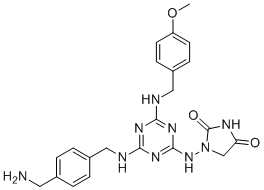
| DC70904 | WEHI-7326 Featured |
WEHI-7326 (WEHI 7326) is a specifi mitotic inhibitor and potential anticancer agent, causes cell cycle arrest in G2/M, cell death in vitro (MDA-MB-231 IC50=24.4 nM), and displays efficacious anti-tumor activity in vivo.WEHI-7326 induces cell death in a broad range of cancer cell lines, including taxane-resistant cells, and inhibits growth of human colon, brain, lung, prostate and breast tumors in mice xenografts.WEHI-7326 exceeded potency of myoseverin B by almost ten-fold, did not show any significant cytotoxic activity in vitro (IC50>40 uM) in HepG2 cells.WEHI-7326 prolongs survival in mouse models of high-risk neuroblastoma and leads to complete tumor regression when used in combination with standard-of-care relapse therapies.
More description
|
|
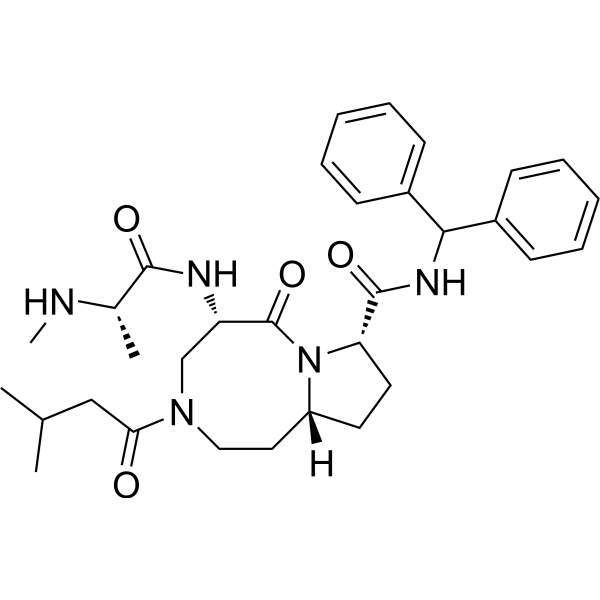
| DC73115 | DEBIO 1143 Featured |
DEBIO 1143 (Xevinapant, AT-406, SM406, ARRY-334543, D1143) is a potent, orally active Smac mimetic that antagonizes cIAP1, cIAP2 and XIAP with Ki of 66.4, 1.9 and 5.1 nM, respectively.
More description
|
|
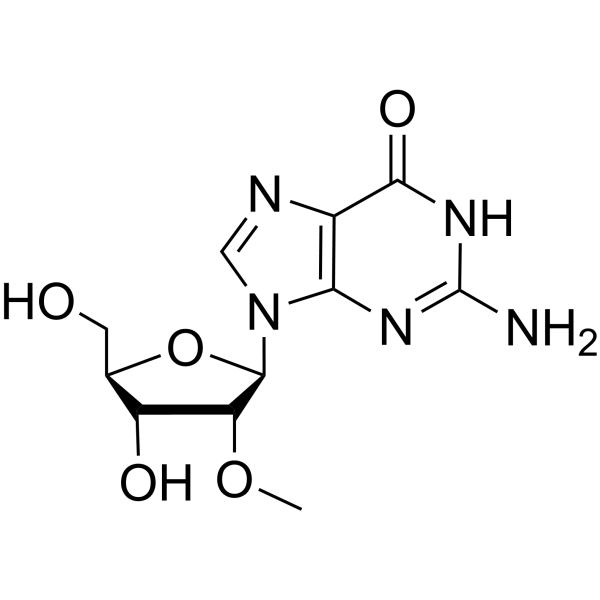
| DC44537 | 2'-O-Methylguanosine Featured |
2'-O-Methylguanosine is a modified nucleoside produced in tRNAs by the action of tRNA guanosine-2’-O-methyltransferase. 2'-O-Methylguanosine results in apoptotic changes of cells.
More description
|
|
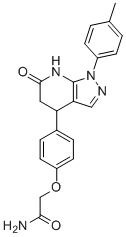
| DC73120 | J012-3168 Featured |
RPL11-MDM2 inhibitor S9 (J012-3168) is a small-molecule RPL11 mimetic and potential inhibitor of RPL11-MDM2 interaction, directly binds MDM2 and induces p53 stabilization and activation.
More description
|
|
| DC9296 | A-1331852 Featured |
A-1331852 is a high affinity BH3 mimetic Ligand of BCL protein BCL-XL.
More description
|
|
| DC79863 | DC-5163 |
DC-5163 is a potent glyceraldehyde-3-phosphate dehydrogenase (GAPDH) inhibitor with an IC50 of 176.3 nM and a Kd of 3.192 μM. DC-5163 can inhibit glycolysis pathway partially. DC-5163 also selectively inhibits cancer cell proliferation and induces apoptosis.
More description
|
|
| DC79851 | Ac-LEVD-CHO TFA |
Ac-LEVD-CHO (TFA) is an inhibitor of caspase-4. Ac-LEVD-CHO (TFA) can inhibit the expression and secretion of IL-1α expression as well as the activation of caspase-4 induced by the T. denticola periodontal pathogen surface protein Td92 in human gingival fibroblasts. Ac-LEVD-CHO (TFA) can also reduce the apoptosis due to the expression of the dominant negative adenoviral RNA-dependent protein kinase in A549 and PC3 cancer cell lines.
More description
|
|
| DC79791 | NPB-1575 |
NPB-1575 is a potent, orally active and brain-penetrant anti-inflammatory agent. NPB-1575 mitigates neuroinflammation and resists ferroptosis by activating the IRS2/Nrf2/NF-κB axis. NPB-1575 shows protective effect against cerebral ischemic injury and improves the neurological functional prognosis. NPB-1575 can be used for the study of ischemic stroke.
More description
|
|
| DC79754 | Sphingosine (d18:1(14Z)) |
Sphingosine (d18:1(14Z)) is an atypical sphingolipid that has a cis double bond at the 14-15 position. Sphingosine is a negative regulator of cell proliferation and can promote apoptosis.
More description
|
|
