 To enhance service speed and avoid tariff delays, we've opened a US warehouse. All US orders ship directly from our US facility.
| Cat. No. | Product Name | Field of Application | Chemical Structure |
|---|---|---|---|
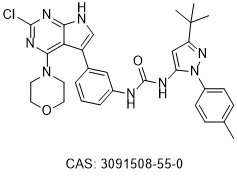
| DC78463 | RN277 Featured |
RN277 is an inhibitor for LRRK2 type II kinase. RN277 can be used as a cellular tool targeting the LRRK2 inactive state. RN277 can inhibit LRRK1 kinase activity in vitro. RN277 inhibits LRRK2 kinase activity in vitro (IC50 = 70 nM). RN277 reduces phosphorylation of Rab8a dose-dependently. RN277 can be studied in research for Parkingson’s disease.
More description
|
|
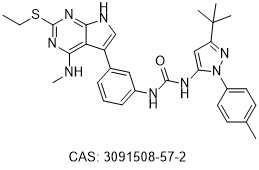
| DC79310 | RN341 Featured |
RN341 is a specific type II kinase inhibitor of LRRK2 (IC50: 296 nM). RN341 inhibits LRRK2 phosphorylation and avoids S935 dephosphorylation by stabilizing the open conformation. RN341 rescues LRRK2-mediated kinesin motility block by preventing microtubule binding. RN341 effectively inhibits LRRK2 wild-type and G2019S mutant at the cellular level. RN341 provides a new direction for Parkinson's disease research.
More description
|
|
| DC81370 | PROTAC EZH2 Degrader-43 |
PROTAC EZH2 Degrader-43 (compound 59) is a PROTAC protein degrader targeting EZH2 with an IC50 of 21.73 μM against SU-DHL-6 cells. PROTAC EZH2 Degrader-43 can be used for the research of lymphoma.
(Pink: Histone Methyltransferase ligand ; Blue: VHL ligand ; Black: linker).
More description
|

|
| DC80950 | LDH-IN-5 |
LDH-IN-5 is a Lactate Dehydrogenase (LDH) inhibitor with neuroprotective activity. LDH-IN-5 can inhibit cell apoptosis, reduce ROS, MDA production and increases superoxide dismutase (SOD) activity. LDH-IN-5 can be used for the research of neurological disease, such as ischemic stroke.
More description
|
|
| DC80844 | IKKε-IN-1 |
IKKε-IN-1 is a IKKε inhibitor. IKKε-IN-1 reduces cell viability, inhibits colony formation and cell migration. IKKε-IN-1 induces autophagy (Autophagy) in cancer cells. IKKε-IN-1 can be used in the research of cancers including colorectal cancer, hepatocellular carcinoma, bladder cancer, breast cancer, lung cancer, and cervical cancer.
More description
|
|
| DC80778 | HDAC6-IN-75 |
HDAC6-IN-75 is a selective HDAC6 inhibitor with an IC50 of 0.17 nM against HDAC6. HDAC6-IN-75 induces the accumulation of acetylated α-tubulin in glioma cells. HDAC6-IN-75 triggers cell cycle changes, increases the SubG1 cell population, and promotes apoptosis in glioma cells and glioblastoma stem cells. HDAC6-IN-75 is applicable for glioma-related research.
More description
|
|
| DC80018 | 2-((tert-Butyldimethylsilyl)oxy)ethanol |
2-((tert-Butyldimethylsilyl)oxy)ethanol is a PROTAC linker that can be used in the synthesis of PROTACs.
More description
|

|
| DC79909 | (R)-SLB1122168 free base |
(R)-SLB1122168 free base, an isomer of SLB1122168 free base, is a spinster homolog 2 (SPNS2) inhibitor with an IC50 ≤2 μM.
More description
|
|
| DC79800 | ML-20 |
ML-20, Malabaricone C analogue, is a autophagy inhibitor and radiosensitizer. ML-20 inhibits cell growth, induces cell apoptosis . ML-20 induces DNA double-strand breaks, loss of mitochondrial membrane potential (MMP), and lysosomal membrane permeabilization (LMP). ML-20 induces endoplasmic reticulum stress and concurrent inhibition of autophagy flux due to LMP .
More description
|
|
| DC79766 | LCL768 |
LCL768 is a ceramide analog. LCL768 attenuates PARKIN succination to promote PARKIN activation and mitophagy. LCL768 induces CerS1-mediated endogenous C18-ceramide accumulation in mitochondria to mediate mitophagy, which is dependent on DRP1 activation via nitrosylation at C644. LCL768 alters mitochondrial metabolism, resulting in fumarate depletion and leading to tumor suppression. LCL768 improves sensorimotor defects in neurodegenerative diseases like ALS.
More description
|
|
| DC79509 | Y040-7904 |
Y040-7904 is a mitophagy activator. Y040-7904 enhances mitophagy by promoting mitochondria transport to autophagosomes and the fusion of autophagosomes with autolysosomes. Y040-7904 induces mitophagy through the SIRT1/FoxO3 pathway. Y040-7904 upregulates the levels of Parkin, PINK1, and LC3II/I. Y040-7904 reduces amyloid-β (Aβ) accumulation in both in vitro and in vivo models of Alzheimer’s disease.
More description
|
|
| DC78527 | IITZ-02 |
IITZ-02 is a lysosomotropic Autophagy inhibitor. IITZ-02 enhances autophagosome accumulation but inhibits autophagosomal degradation by impairing lysosomal function, finally inducing the inhibition of autophagy. IITZ-02 abolishes mitochondrial membrane potential and induces apoptosis through the mitochondria-mediated pathway. IITZ-02 has a potent antitumor activity in MDA-MB-231 xenograft mouse models. IITZ-02 can be used for cancers research.
More description
|
|
| DC78475 | AR493 |
AR493 is an autophagy activator acting on AMPK (adenosine monophosphate-activated protein kinase). AR493 regulates pathways related to cellular energy sensing and increases autophagy levels. AR493 is promising for research of aging-associated diseases (such as diabetes, neurodegenerative diseases) and autophagy regulation.
More description
|
|
| DC78228 | CR-3294 |
CR-3294 is an autophagy inducer in hypoxic cells. CR-3294 is an inducible enzyme nitric oxide synthase (iNOS) inhibitor. CR-3294 inhibits both the DNA binding of HIF-1alpha and VEGF mRNA synthesis. CR-3294 can be used for the study of breast cancer and inflammatory bowel disease (IBD), such as Crohn’s disease, ulcerative colitis.
More description
|
|
| DC78154 | (R)-CMPD-39 |
(R)-CMPD-39 is the R enantiomer of CMPD-39. CMPD-39 is a selective non-covalent inhibitor of the ubiquitin-specific protease USP30 (IC50 =~20 nM), with high selectivity over other DUB family members (1-100 μM). CMPD-39 inhibits the deubiquitinating activity of USP30, enhances the ubiquitination of mitochondrial proteins TOMM20 and SYNJ2BP; thus, CMPD-39 promotes phosphoubuitin accumulation, thereby accelerating mitochondrial autophagy (mitophagy) and peroxisomal autophagy (pexophagy). CMPD-39 significantly restores impaired mitochondrial function in dopaminergic neurons derived from Parkinson's disease patients.
More description
|
|
| DC76168 | SHS206 |
SHS206 (compound 6n) is an orally active mitochondrial uncoupler that reduces hepatic triglyceride levels. SHS206 exhibits in vivo efficacy in the GAN mouse model and shows inhibitory effects on metabolic dysfunction-associated steatohepatitis (MASH).
More description
|
|
| DC76167 | CHD-1 |
CHD-1 is a a hypoxia-activated antitumor prodrug. CHD-1 impairs mitochondrial morphology and membrane potential in hypoxic tumor cells, further triggering excessive mitophagy and inducing apoptosis. CHD-1 inhibits the growth of hypoxic tumor cells in vitro and the growth of HeLa xenograft in vivo.
More description
|
|
| DC76166 | SRI-31255 |
SRI-31255 is an orally active LRRK2 inhibitor with IC50 values of 520 and 427 nM for human wild-type (WT) and mutant G2019S, respectively. SRI-31255 exerts neuroprotective effects by binding to the ATP-binding pocket of LRRK2, inhibiting kinase activity. SRI-31255 can be used as a lead compound for the development of LRRK2-targeted drugs for the treatment of Parkinson's disease.
More description
|
|
| DC76165 | Nilotinib hydrochloride dihydrate |
Nilotinib (AMN107) hydrochloride dihydrate is an orally active Bcr-Abl tyrosine kinase inhibitor with antineoplastic activity and can be used in studies of chronic myelogenous leukaemia.
More description
|
|
| DC76164 | Lentztrehalose B |
Lentztrehalose B is a dehydroxylated analog of trehalose A, possessing antioxidant properties that can be used in research on neurodegenerative diseases and other autophagy-related conditions.
More description
|
|
| DC76163 | DQ661 |
DQ661 is a potent PPT1 inhibitor. DQ661 is a dimeric quinacrine autophagy inhibitor. DQ661 inhibits mTORC1 activity. DQ661 decreases the protein expression of pS6K T389, pS6 S240-244. DQ661 shows anticancer activity.
More description
|
|
| DC76162 | ATG16L1 stabilizer-1 |
ATG16L1 stabilizer-1 (compound A3B) is an FKBP12-independent ATG16L1 stabilizer that promotes cellular Autophagy. ATG16L1 stabilizer-1 inhibits ATG16L1 with an EC50 of 12.1 μM in the presence or absence of FKBP12. ATG16L1 stabilizer-1 alone induces GFP-LC3 puncta formation to a small extent with an EC50 of 12.0 μM.
More description
|
|
| DC48753 | DC-LC3in-D5 Featured |
DC-LC3in-D5 acts as an autophagy inhibitor by attenuating LC3B lipidation. DC-LC3in-D5 binds with LC3B. DC-LC3in-D5 disrupts the LC3B-LBP2 interaction with an IC50 of 200 nM. DC-LC3in-D5 may contribute to anti-HCV or combination treatments in cancer through inhibiting autophagy.
More description
|

|
| DC73152 | SW120619 Featured |
SW120619 is a specific small molecule inhibitor of WNK3 kinase with IC50 of 0.7 uM, weakly inhibits WNK1 and WNK2 with IC50 of 2.3 and 16.8 uM, respectively.
More description
|

|
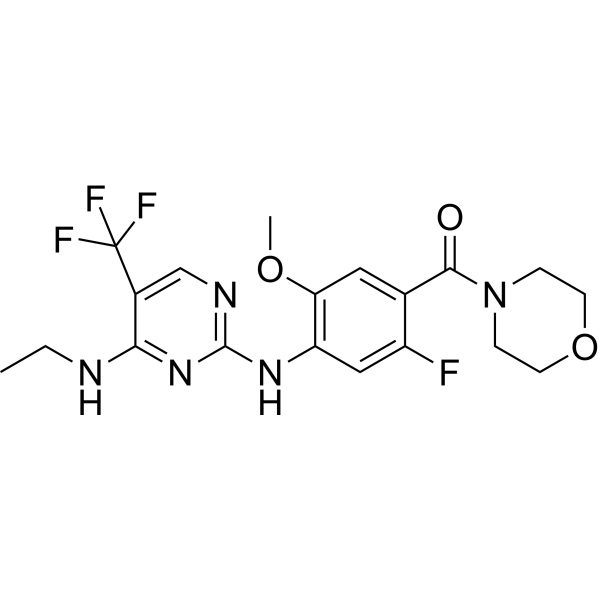
| DC7419 | GNE-7915 Featured |
GNE-7915 is a highly potent, selective, and brain-penetrable LRRK2 small molecule inhibitor with IC50 of 9 nM in cellular LRRK2 assay; > 100 fold selectivity against a panel of 187 kianses(Ki).
More description
|
|
| DC12331 | XRK3F2 |
XRK3F2 is an inhibitor of p62 (Sequestosome-1)-ZZ/ domain.
More description
|

|
| DC72873 | MTK458 Featured |
MTK458 (MTK-458) is a potent, selective and brain penetrant PINK1 activator, MTK-458 promotes the first step in mitophagy.
MTK458 selectively activates PINK1 by stimulating dimerization and stabilization of the PINK1/TOM complex.
MTK458 binds to PINK1 and stabilizes an active heterocomplex, thereby increasing mitophagy.
MTK458 reduces the PINK1 substrate pS65-Ubiquitin (pUb) in primary neurons and in vivo.
MTK458 drives clearance of pathologic α-synuclein in vitro and in vivo, decreases pS129 α-synuclein aggregates and normalized both brain and corresponding plasma pUb levels in both cellular and animal models of α-synuclein aggregation (PD-like pathology).
More description
|

|
| DC73146 | MK-1468 Featured |
MK-1468 is a potent, selective, brain-penetrant LRRK2 inhibitor with IC50 of 0.4 nM (G2019S LRRK2), potently inhibits the phosphorylation of LRRK2 serine 935 (pSer935) in hPBMCs with IC50 of 2.8 nM.
More description
|

|
| DC73145 | FX2149 Featured |
FX2149 (FX 2149) is a potent, BBB permeable inhibitor of LRRK2 GTP binding activity with IC90 of 10 nM, reduces PD-linked mutant LRRK2 variants (G2019S and R1441C) that bound with GTP.
More description
|

|
| DC72558 | GLPG3970 Featured |
GLPG3970 (compound 88) is a first-in-class SIK2/SIK3 inhibitor. GLPG3970 can be used for the research of inflammation and autoimmune disease.
More description
|

|
