 To enhance service speed and avoid tariff delays, we've opened a US warehouse. All US orders ship directly from our US facility.
| Cat. No. | Product Name | Field of Application | Chemical Structure |
|---|---|---|---|
| DC80255 | ARI-809 |
ARI-809 (CP-744809) is a highly selective, orally active aldose reductase inhibitor with an IC50 of 1 nM. ARI-809 blocks excessive glucose flux through the polyol pathway. ARI-809 normalizes elevated sorbitol and fructose levels in sciatic nerve tissues of diabetic rat models, inhibits sorbitol accumulation in lens tissues, and brings elevated urinary albumin excretion close to normal. ARI-809 can be used in diabetes research.
More description
|

|
| DC80248 | Apoptosis inducer 60 |
Apoptosis inducer 60 (Compound 4a) is an Apoptosis inducer. Apoptosis inducer 60 induces concentration-dependent apoptosis in cells. Apoptosis inducer 60 exhibits moderate cytotoxicity against breast cancer cell lines.
More description
|
|
| DC80205 | Antibacterial agent 321 |
Antifungal agent 147 (compound 2) is a lipophilic antibacterial agent with dark toxicity. Antifungal agent 147 shows a phototoxic effect on S. aureus and E. coli. Antifungal agent 147 can penetrate the bacterial cell membrane and disturb its structure, leading to dark toxicity. Antifungal agent 147 can be used for bacteria infection research.
More description
|
|
| DC80201 | Anordrin |
Anordrin is a contraceptive agent. Anordrin exhibits estrogenicites and can induce decrease in serum progesterone levels in rat models. Anordrin inhibits endometrial epithelial cell mitosis and NAFLD induced by Tamoxifen in mouse uterus and liver as an anti-estrogenic and estrogenic agent.
More description
|
|
| DC80185 | ALM-201 |
ALM-201 is a peptide inhibitor of angiogenesis targeting microtubule. ALM-201 can inhibit cells migration, tubule formation and microvessel formation. ALM-201 can be used for the research of cancer.
More description
|
|
| DC80166 | AGN-191659 |
AGN-191659 is an orally active RAR/RXR agonist with EC50 values of 11 nM, 23 nM, and 37 nM for RXRα, RARβ, and RARγ, respectively. AGN-191659 activates RXRα, RARβ and RARγ to induce gene transcription. AGN-191659 induces tissue transglutaminase activity, inhibits ornithine decarboxylase activity induced by tumor promoters, and suppresses chondrogenesis. AGN-191659 reverses basic fibroblast growth factor-induced endothelial cell proliferation. AGN-191659 induces hypertriglyceridemia in rat models. AGN-191659 inhibits total heparin-releasable lipase activity. AGN-191659 can be used in research related to promyelocytic leukemia and hypertriglyceridemia.
More description
|
|
| DC80160 | AEG40826 |
AEG40826 (HGS1029), a second mitochondria-derived activator of caspases (SMAC) mimetic, is an inhibitor of apoptosis (IAP) inhibitor. AEG40826 degrades cellular IAP1 (cIAP1) and blocks TNF-α pro-survival signaling. AEG40826 can be used for cancer research.
More description
|
|
| DC80147 | AChE-IN-103 |
AChE-IN-103 (Compound 10) is an inhibitor of ACh. AChE-IN-103 exhibits log IC50 values of 1.477 and 2.2 for models based on alignments I and II. AChE-IN-103 can be studied in research on Alzheimer’s disease.
More description
|
|
| DC80131 | 9,10-Epoxy13-hydroxy-11-octadecenoic acid |
9,10-Epoxy13-hydroxy-11-octadecenoic acid is a fatty acid.
More description
|
|
| DC80129 | 9(E)-Monohexadecenoin |
9(E)-Monohexadecenoin is an acylglycerol.
More description
|
|
| DC80097 | 5-Carboxyamino-1-(5-phospho-D-ribosyl)imidazole |
5-Carboxyamino-1-(5-phospho-D-ribosyl)imidazole is a nucleoside metabolite.
More description
|
|
| DC80094 | 4-PSQ |
4-PSQ is an orally active neuroprotective agent. 4-PSQ possesses both antioxidant and anti-inflammatory activities. 4-PSQ improves cognitive impairment and depressive- and anxiety-like emotional abnormalities in mice by regulating the activity of Na+, K+-ATPase, the NFκB signaling pathway, and the expression of p21. 4-PSQ can be used for the research of neurological diseases.
More description
|
|
| DC80092 | 4-Methylthio-2-oxobutanoic acid |
4-Methylthio-2-oxobutanoic acid (MTOB) is an ornithine decarboxylase inhibitor. 4-Methylthio-2-oxobutanoic acid reduces ornithine decarboxylase protein levels and enzymatic activity. 4-Methylthio-2-oxobutanoic acid is formed in cells in the Met salvage pathway from methylthioadenosine. 4-Methylthio-2-oxobutanoic acid inhibits cancer cells growth. 4-Methylthio-2-oxobutanoic acid can be used for the research of cancer.
More description
|
|
| DC80039 | 2-Dimethylaminophenol |
2-Dimethylaminophenol is an inhibitor of human glyoxalase 1 (GLO1). 2-Dimethylaminophenol disrupts metal binding by substituting the pyridine nitrogen donor with a dimethylamino group.
More description
|
|
| DC79996 | 1-Decanoin-2-palmitin |
1-Decanoin-2-palmitin is an acylglycerol.
More description
|
|
| DC79981 | 11β-HSD1-IN-24 |
11β-HSD1-IN-24 (Compound 10l) is a potent and selective 11β-HSD1 inhibitor with an IC50 of 0.5 nM. 11β-HSD1-IN-24 can effectively block the conversion of inactive Cortisone to active Cortisol. 11β-HSD1-IN-24 can be used for the research of metabolic disease, such as type 2 diabetes.
More description
|
|
| DC80003 | 1-Laurin-2-decanoin |
1-Laurin-2-decanoin is an acylglycerol.
More description
|

|
| DC79968 | 1,3-Palmitin-2-laurin |
1,3-Palmitin-2-laurin is an acylglycerol.
More description
|
|
| DC79941 | 1,2-Arachidin-3-stearin |
1,2-Arachidin-3-stearin is a lipid that can be used to prepare lipid nanoparticles (LNPs) for drug delivery.
More description
|
|
| DC79926 | (S)-JQ-35-Boc |
(S)-JQ-35-Boc is a BRD4 ligand. (S)-JQ-35-Boc can be used to synthesize BRD4 degrader RAJQ14. RAJQ14 can be used for cancer research.
More description
|
|
| DC79895 | (4S,11R)-DiHDoHE |
(4S,11R)-DiHDoHE is a derivative of Dihydroxy-DHA.
More description
|
|
| DC79889 | (2Z,4E)-5-Hydroxypenta-2,4-diene-1,2,5-tricarboxylic acid |
(2Z,4E)-5-Hydroxypenta-2,4-diene-1,2,5-tricarboxylic acid is a 5-hydroxypenta-2,4-diene-1,2,5-tricarboxylic acid.
More description
|
|
| DC79875 | (±)-Homoproline |
(±)-Homoproline (2-Pyrrolidineacetic acid) is the precursor for the biosynthesis of Tussilagine and Isotussilagine. (±)-Homoproline can be used in neurological research.
More description
|
|
| DC77909 | 10-Butyl Ether Minocycline |
10-Butyl Ether Minocycline (BEM), a Minocycline derivative, is an MMP-8 and MMP-9 inhibitor with IC50s of 69.4 µM and 47.0 µM, respectively. 10-Butyl Ether Minocycline suppresses LPS-induced microglial activation. 10-Butyl Ether Minocycline inhibits VEGF-induced endothelial cell migration and L-Glutamine-induced ROS levels. 10-Butyl Ether Minocycline significantly reduces alcohol consumption in the Chronic Intermittent Ethanol (CIE) mouse model of alcohol dependence. 10-Butyl Ether Minocycline can be used for the study of neuroimmune-inflammatory diseases and Alcohol use disorder (AUD).
More description
|
|
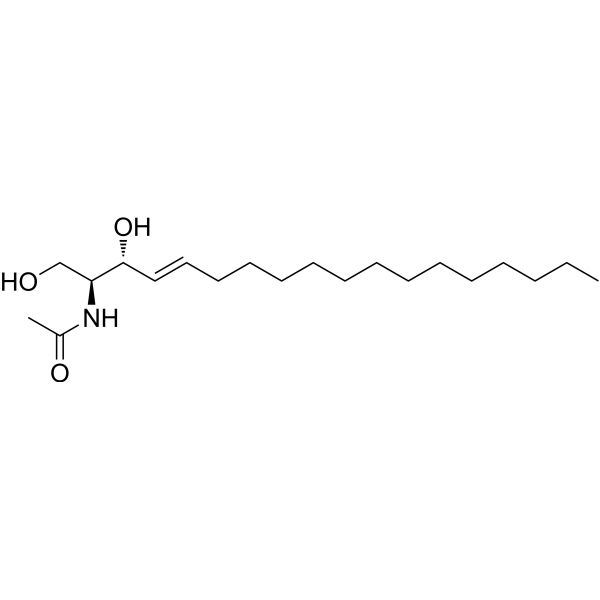
| DC40023 | C2 Ceramide Featured |
C2 Ceramide (Ceramide 2) is the main lipid of the stratum corneum and a protein phosphatase 1 (PP1) activator. C2 Ceramide activates PP2A and ceramide-activated protein phosphatase (CAPP). C2 Ceramide induces cells differentiation and apoptosis, inhibits mitochondrial respiratory chain complex III. C2 Ceramide is also a skin conditioning agent that protects the epidermal barrier from water loss.
More description
|
|
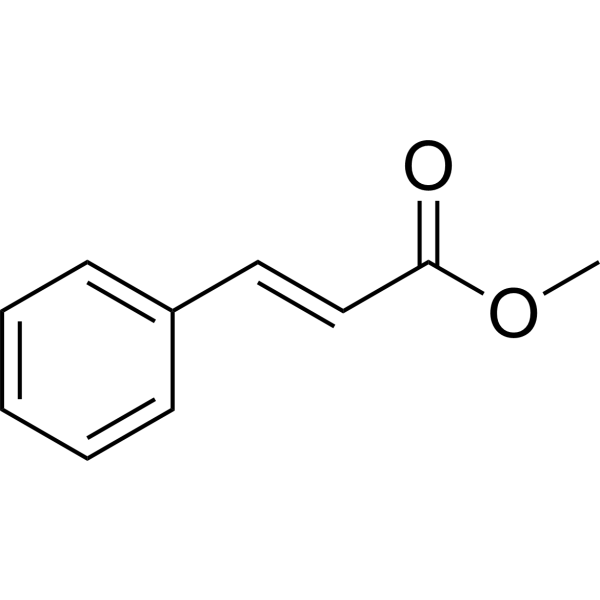
| DC29188 | Methyl cinnamate |
Methyl cinnamate (Methyl 3-phenylpropenoate), an active component of Zanthoxylum armatum, is a widely used natural flavor compound. Methyl cinnamate (Methyl 3-phenylpropenoate) possesses antimicrobial activity and is a tyrosinase inhibitor that can prevent food browning. Methyl cinnamate (Methyl 3-phenylpropenoate) has antiadipogenic activity through mechanisms mediated, in part, by the CaMKK2-AMPK signaling pathway.
More description
|
|
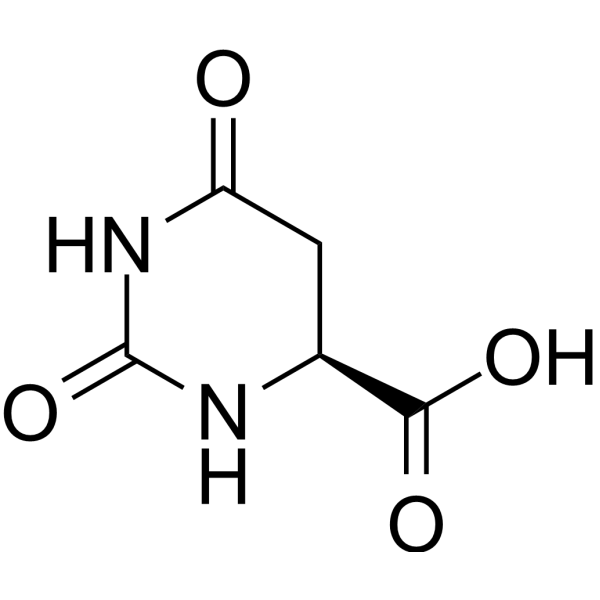
| DC29184 | L-Dihydroorotic acid Featured |
L-Dihydroorotic acid can reversibly hydrolyze to yield the acyclic L-ureidosuccinic acid by dihydrowhey enzyme.
More description
|
|
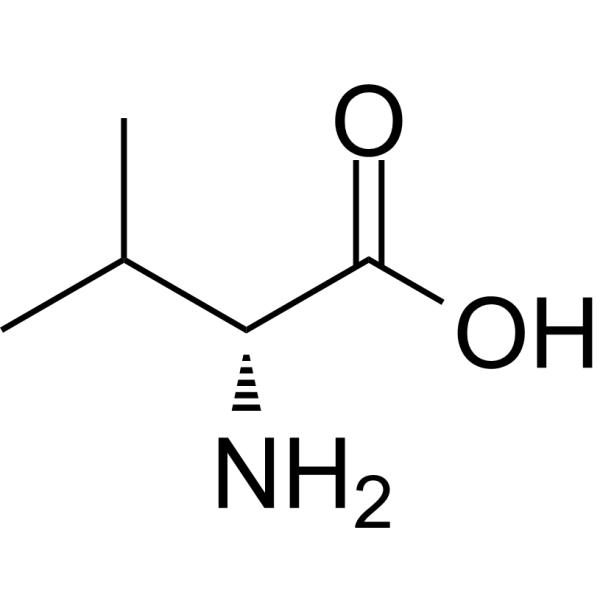
| DC41297 | D-Valine Featured |
D-Valine is the enantiomer of L-Valine. L-Valine is one of 20 proteinogenic amino acids. L-Valine is an essential amino acid.
More description
|
|
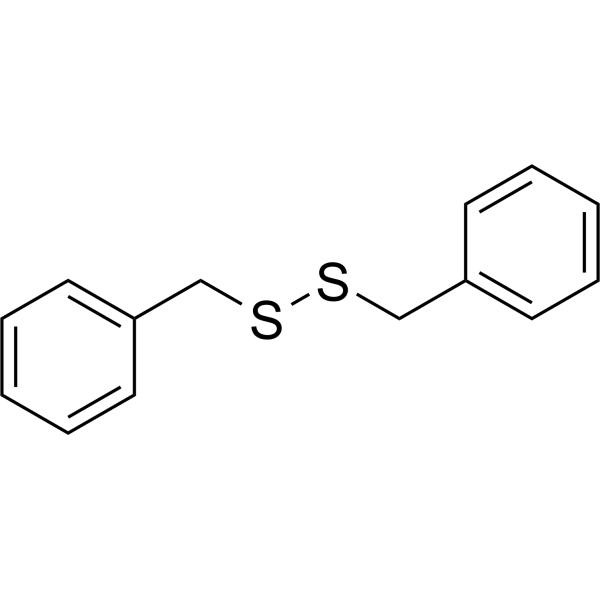
| DC42106 | Dibenzyl disulfide Featured |
Dibenzyl disulfide is an endogenous metabolite.
More description
|
|
| DC49409 | Glucose oxidase Featured |
Glucose oxidase is used in the food and beverage industry as a preservative and stabilizer and is commonly derived from the fungus Aspergillus niger. Glucose oxidase can react with intracellular glucose and oxygen (O2) to produce hydrogen peroxide (H2O2) and gluconic acid, which can cut off the nutrition source of cancer cells and consequently inhibit their proliferation.
More description
|
|
