 To enhance service speed and avoid tariff delays, we've opened a US warehouse. All US orders ship directly from our US facility.
| Cat. No. | Product Name | Field of Application | Chemical Structure |
|---|---|---|---|
| DC71475 | PXYD4 |
PXYD4 is a ribosomal protein S1 (RpsA) antagonist with Kds of 3.24 and 1.64 μM for RpsA-CTD and RpsA-CTD Δ438A, respectively. RpsA plays an important role in the trans-translation process of Mycobacterium Tuberculosis (Mtb).
More description
|

|
| DC71473 | LA-Bac8c |
LA-Bac8c is a Lipoic acid modified antimicrobial peptide with enhanced antimicrobial properties. LA-Bac8c inhibits S. aureus, MRSA, S. epidermidis, E. coli, and P. aeruginosa with MICs of 1, 4, 8, 8, and 8 μg/mL.
More description
|
|
| DC71472 | Tibezonium iodide |
Tibezonium iodide, an oropharyngeal disinfectant, has antibacterial activity for the prevention of mouth infections.
More description
|
|
| DC71471 | ADG-2e |
ADG-2e is a potent antibacterial agent with MICs of 16, 4, 2, and 2 μg/mL for E. coli [KCTC 1682], P. aeruginosa [KCTC 1637], B.subtilis [KCTC 3068], and S. aureus [KCTC 1621], respectively. ADG-2e shows anti-metastatic activity against breast cancer cells.
More description
|
|
| DC71470 | PXYD3 |
PXYD3 is a ribosomal protein S1 (RpsA) antagonist with Kds of 5.66 and 6.91 μM for RpsA-CTD and RpsA-CTD Δ438A, respectively. RpsA plays an important role in the trans-translation process of Mycobacterium Tuberculosis (Mtb).
More description
|
|
| DC71469 | PXYC1 |
PXYC1 is a ribosomal protein S1 (RpsA) antagonist with Kds of 0.81 and 0.31 μM for RpsA-CTD and RpsA-CTD Δ438A, respectively. RpsA plays an important role in the trans-translation process of Mycobacterium Tuberculosis (Mtb).
More description
|
|
| DC71468 | PXYC2 |
PXYC2 is a ribosomal protein S1 (RpsA) antagonist with Kds of 6.35 and 5.11 μM for RpsA-CTD and RpsA-CTD Δ438A, respectively. RpsA plays an important role in the trans-translation process of Mycobacterium Tuberculosis (Mtb).
More description
|
|
| DC71467 | PXYC13 |
PXYC13 is a ribosomal protein S1 (RpsA) antagonist with Kds of 7.61 and 8.50 μM for RpsA-CTD and RpsA-CTD Δ438A, respectively. RpsA plays an important role in the trans-translation process of Mycobacterium Tuberculosis (Mtb).
More description
|
|
| DC71465 | VP-4556 |
VP-4556 is a potent anti-methicillin-resistant Staphylococcus aureus (MRSA) agent. VP-4556 exhibits significant microbial growth inhibition toward Staphylococcus aureus (ATCC 43300) with MIC of 8 µg/mL. VP-4556 inhibits the growth of methicillin‐resistant Staphylococcus aureus with growth inhibition >95%.
More description
|
|
| DC71464 | PXYC12 |
PXYC12 is a ribosomal protein S1 (RpsA) antagonist with Kds of 2.67 and 4.67 μM for RpsA-CTD and RpsA-CTD Δ438A, respectively. RpsA plays an important role in the trans-translation process of Mycobacterium Tuberculosis (Mtb).
More description
|
|
| DC71462 | CRS3123 dihydrochloride |
CRS3123 (REP-3123) dihydrochloride, a fully synthetic antibacterial agent, potently inhibits methionyl-tRNA synthetase (MetRS) of Clostridioides difficile, inhibiting Clostridioides difficile toxin production and spore formation. CRS3123 dihydrochloride is an oral agent for the research of Clostridioides difficile infection (CDI).
More description
|
|
| DC71461 | S-14506 hydrochloride |
S-14506 hydrochloride is a potent 5-HT1A agonist. S-14506 hydrochloride displays dopamine antagonist properties by blocking dopamine D2 receptors. S-14506 hydrochloride inhibits the in vivo binding of [3H]raclopride in striatum and olfactory bulbs. S-14506 hydrochloride has the potential for the research of anxiolytic agent.
More description
|
|
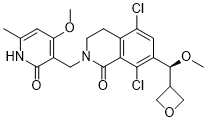
| DC60234 | PF-06821497 Featured |
PF-06821497 (compound 23a) is a potent, selective and orally active Enhancer of Zeste Homolog 2 (EZH2) inhibitor, with a Ki value <0.1 nM against mutant Y641N EZH2. Exhibits robust tumor growth inhibition.
More description
|
|
| DC60241 | FluvoxaMine Featured |

|
|
| DC60239 | Uridine 5′-diphosphoglucose Featured |

|
|
| DC60237 | 7-Chlorokynurenic acid sodium salt Featured |

|
|
| DC60235 | Hydrazinium hydroxide Featured |

|
|
| DC71300 | Branaplam hydrochloride Featured |
Branaplam (LMI070; NVS-SM1) hydrochloride is a highly potent, selective and orally active survival motor neuron-2 (SMN2) splicing modulator with an EC50 of 20 nM for SMN. Branaplam hydrochloride inhibits human-ether-a-go-go-related gene (hERG) with an IC50 of 6.3 μM. Branaplam hydrochloride elevates full-length SMN protein and extends survival in a severe spinal muscular atrophy (SMA) mouse model.
More description
|

|
| DC10194 | FMK 9a Featured |
FMK 9a is an autophagin-1 inhibitor with IC50 values of 80 and 73 μM in FRET and LRA assay.
More description
|

|
| DC46369 | GSK215 Featured |
GSK215 is a potent and selective PROTAC focal adhesion kinase (FAK) degrader. GSK215 is designed by a binder for the VHL E3 ligase and the FAK inhibitor VS-4718. GSK215 induces rapid and prolonged FAK degradation, giving a long-lasting effect on FAK levels and a marked pharmacokinetic/pharmacodynamics (PK/PD) disconnect.
More description
|

|
| DC60233 | WYE-176092 Featured |

|
|
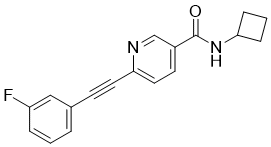
| DC60229 | VU0360172 Featured |
VU0360172 is a positive allosteric modulator of mGlu5 receptors (EC50 = 16 nM; Ki = 195 nM). VU0360172 is selective for mGlu5 and it displays no significant activity at mGlu1, mGlu2 or mGlu4 receptors.
More description
|
|
| DC60228 | KCNQ1 activator-1 Featured |

|
|
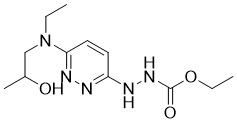
| DC60227 | Cadralazine Featured |
Cadralazine is a peripheral arteriolar vasodilator and an antihypertensive drug.
More description
|
|
| DC60226 | Beclamide Featured |
Beclamide is a drug that possesses anticonvulsant activity. It is no longer used. Beclamide is possibly metabolized to 3-chloropropanoic acid in vivo, which binds to the GHB receptor. It has been used as a sedative and as an anticonvulsant. It was studied in the 1950s for its anticonvulsant properties, as a treatment for generalised tonic-clonic seizures. It was not effective for absence seizures. Interest in the drug resumed in the 1990s for its psychiatric properties as an adjunct in the treatment of schizophrenia. While not classified as a DEA controlled substance in the United States, this product can only be sold STRICTLY to universities and research institutions. This product will not be sold to individuals or shipped to residential addresses.
More description
|

|
| DC34272 | SPP-86 Featured |
SPP-86 is a potent RET inhibitor.
More description
|

|
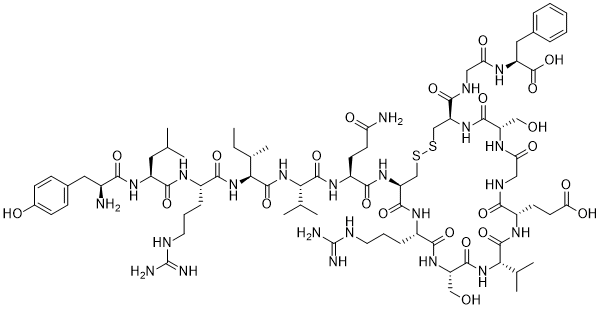
| DC60225 | AOD-9604 Featured |
AOD-9604 is a potential anti-obesity peptide based on human growth hormone. AOD9604 was originally developed after research on mice, but subsequent studies in human have shown no efficacy for the potential treatment of obesity.
More description
|
|
| DC60224 | WAY-270599 Featured |

|
|
| DC60223 | Viridicatol Featured |
Viridicatol is a fungal metabolite that has been found in various Penicillium species as well as Phoma with antimicrobial properties.
More description
|

|
| DC60221 | MKC-1 Featured |
MKC-1 is an orally bioavailable, small-molecule, bisindolylmaleimide cell cycle inhibitor with potential antineoplastic activity. MKC-1 and its metabolites inhibit tubulin polymerization, blocking the formation of the mitotic spindle, which may result in cell cycle arrest at the G2/M phase and apoptosis.
More description
|

|
