 To enhance service speed and avoid tariff delays, we've opened a US warehouse. All US orders ship directly from our US facility.
| Cat. No. | Product Name | Field of Application | Chemical Structure |
|---|---|---|---|
| DC47865 | β-Rubromycin |
β-Rubromycin is a potent and selective inhibitor of human immunodeficiency virus-1 (HIV-1) RNA-directed DNA polymeras (reverse transcriptase). β-Rubromycin is a class of quinone antibacterials.
More description
|

|
| DC47864 | γ-Acetylenic GABA |
γ-Acetylenic GABA (4-Aminohex-5-ynoic acid) is an irreversible inhibitor of GABA-transaminase. γ-Acetylenic GABA can increase the concentration of GABA in rat brain.
More description
|
|
| DC22800 | ML-210 Featured |
A small-molecule probe that selectively kills cells induced to express mutant RAS.
More description
|

|
| DC22834 | Roseoflavin Featured |
Roseoflavin is a chemical analog of FMN and riboflavin that has antimicrobial activity.
More description
|

|
| DC22913 | WEB-2086 Featured |
A potent and specific antagonist of platelet activating factor (PAF) receptor that inhibits PAF-induced human platelet and neutrophil aggregation in vitro with IC50 of 0.17 and 0.36 uM, respectively.
More description
|

|
| DC11481 | AZD-0364 Featured |
AZD-0364 is a potent and selective ERK2 inhibitor extracted from patent WO2017080979A1, compound example 18, has an IC50 of 0.6 nM.
More description
|

|
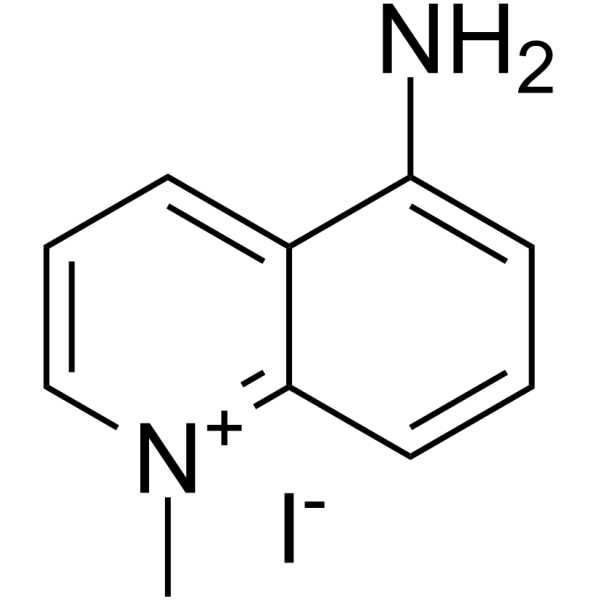
| DC36924 | NNMTi Featured |
NNMTi is a nicotinamide N-methyltransferase (NNMT) inhibitor that promotes myoblast differentiation.
More description
|
|
| DC23191 | ZL-006 Featured |
ZL-006 (ZL 006, ZL006) is a brain penetrant small molecule inhibitor of PSD-95/nNOS interaction that prevents glutamate-induced excitotoxicity and cerebral ischemic damage in vivo.
More description
|

|
| DC23195 | CBR-5884 Featured |
A potent, selective, noncompetitive inhibitor of 3-phosphoglycerate dehydrogenase (PHGDH) with IC50 of 7 uM.
More description
|

|
| DC23211 | SKF 82958 Featured |
A potent, full dopamine D1 agonist.
More description
|

|
| DC23227 | N6-Cyclohexyladenosine Featured |
An adenosine A1 receptor agonist (EC50= 8.2 nM)..
More description
|

|
| DC23237 | Zaprinast Featured |
Zaprinast (M&B 22948) is a potent, cGMP-specific phosphodiesterase inhibitor with IC50 of 0.5-0.76 and 0.15 uM for PDE5 and PDE6 respectively, also is an agonist for GPR35 (EC50=16/840 nM for rat/human GPR35).
More description
|

|
| DC23372 | Olinone Featured |
Olinone is a selective inhibitor for the BET BRD1 with Kd of 3.4/3.7/8.6 uM for BRD4-BrD1/BRD3-BrD1/BRD2-BrD1, respectively, shows high selectivity over BET BRD2 (Kd>300 uM).
More description
|

|
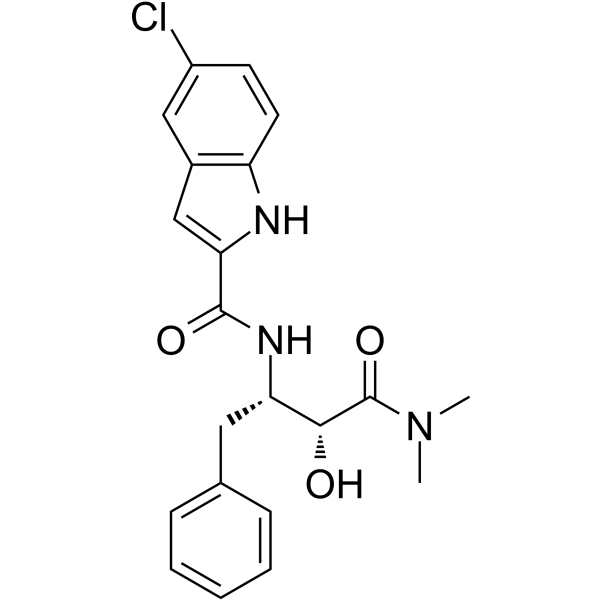
| DC40765 | CP-91149 Featured |
CP-91149 is a GP (glycogen phosphorylase) inhibitor. CP-91149 promotes glycogen resynthesis, but not its overaccumulation. CP-91149 has the potential for Type II (insulin-dependent) diabetes study.
More description
|
|
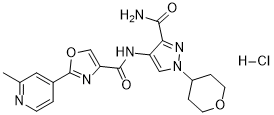
| DC23552 | AS-2444697 HCl Featured |
A potent, selective, orally bioavailable IRAK-4 inhibitor that potently inhibits human and rat IRAK-4 activity with subnanomolar order, >30-fold selectivity over IRAK-1.
More description
|
|
| DC23589 | CGP 37157 Featured |
A specific inhibitor of mitochondrial Na(+)-Ca(2+) exchanger (mNCE) with IC50 of 1.5 uM in INS-1 cells.
More description
|

|
| DC23600 | PF-04856264 Featured |
PF-04856264 is a potent, selective Nav1.7 blocker with IC50 of 28 nM, dispalys >1,000-fold selectivity over Nav1.5.
More description
|

|
| DC23603 | Traxoprodil mesylate Featured |
A potent, selective N-methyl-D-aspartate (NMDA) antagonist with selectivity for the NR2B subunit.
More description
|

|
| DC23604 | ALX-5407 hydrochloride Featured |
ALX-5407 is a potent, selective, orally active inhibitor of GlyT1 glycine transporter with IC50 of 3 nM.
More description
|

|
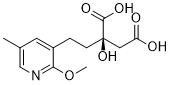
| DC23623 | PF-06761281 Featured |
A potent, selective sodium-coupled citrate transporter (NaCT or SLC13A5) with IC50 of 0.51 uM, >20-fold selectivity over NaDC1 and NaDC3.
More description
|
|
| DC23626 | SCH-28080 Featured |
SCH-28080 is a potent, orally active, reversible inhibitor of gastric H+,K+-ATPase with IC50 of 20 nM.
More description
|

|
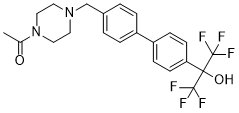
| DC23724 | SR1555 Featured |
SR1555 is a selective RORγ inverse agonist (IC50=1.5 uM) that suppresses T(H)17 cells and stimulates T regulatory cells.
More description
|
|
| DC23732 | KT-5823 Featured |
KT-5823 is a potent, highly specific PKG (cGMP-dependent protein kinase) inhibitor with Ki of 0.234 uM, displays little to no activity for MLCK, cAPK, and PKC.
More description
|

|
| DC23736 | Z62954982 Featured |
Z62954982 is a potent, specific Rac1 inhibitor, reduces the intracellular levels of Rac1-GTP in a concentration-dependent manner with IC50 of 12 uM, 4 times more effective than NSC23766 (IC50=50 uM).
More description
|
|
| DC23781 | YM-1 Featured |
YM-1 is a close derivative of MTK-077 that allosterically promotes Hsp70 binding to unfolded substrates, specificly binds to Hsp70 with Kd of 4.9 uM.
More description
|

|
| DC23834 | Rottlerin Featured |
Rottlerin (Mallotoxin.
More description
|

|
| DC23864 | AAL993 Featured |
AAL993 (ZK260253) is a potent, orally active VEGFR inhibitor with IC50 of 130, 23 and 18 nM for VEGFR-1, 2 and 3, respectively.
More description
|

|
| DC23934 | FTI-277 Featured |
A peptide mimetic of the C-terminal Cys-Val-Ile-Met of K-Ras4B that potently inhibits FTase (Farnesyltransferase) with IC50 of 0.5 nM.
More description
|

|
| DC23962 | Cilobradine Featured |
A hyperpolarization-activated cyclic nucleotide-gated (HCN) channel.
More description
|

|
| DC24118 | C75 Featured |
C75 is an inhibitor synthetic fatty-acid synthase (FASN) and inhibits prostate cancer cells PC3 (IC50: 35 μM).
More description
|

|
