 To enhance service speed and avoid tariff delays, we've opened a US warehouse. All US orders ship directly from our US facility.
| Cat. No. | Product Name | Field of Application | Chemical Structure |
|---|---|---|---|
| DC28233 | CYM 50308 Featured |
CYM50308 is a potent, selective and high affinity sphingosine-1-phosphate receptor 4 (S1P4-R) agonist with an EC50 of 56 nM. CYM50308 displays 37-fold more selective for S1P4-R than S1P5-R. CYM50308 has no activity at S1P1-R, S1P2-R and S1P3-R subtypes at concentrations up to 25 μM.
More description
|

|
| DC43054 | BC-1258 Featured |
Unique F-box/LRR-repeat protein 2 (FBXL2) activator
More description
|

|
| DC22293 | AZ-505 ditrifluoroacetate Featured |
AZ505 ditrifluoroacetate is a potent and selective SMYD2 inhibitor with IC50 of 0.12 μM.
More description
|

|
| DC42670 | BMS-191011 Featured |
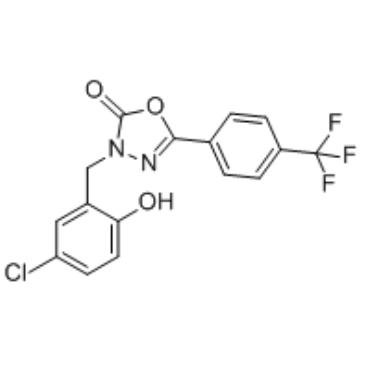
BMS 191011 is an activator of large-conductance calcium-activated potassium (BKCa) channels that increases maximum potassium current to 126% of control in X. laevis oocytes expressing human BKCa channels when used at a concentration of 1 μM.
More description
|
|
| DC8744 | PD318088 Featured |
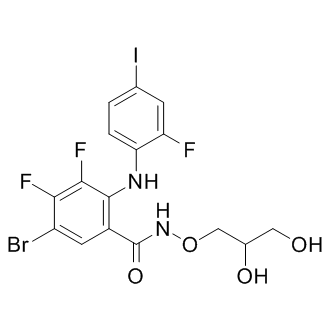
PD318088 is a non-ATP competitive allosteric MEK1/2 inhibitor, binds simultaneously with ATP in a region of the MEK1 active site that is adjacent to the ATP-binding site.
More description
|
|
| DC12677 | AZ876 Featured |
AZ876 is a novel high-affinity LXR agonist.
More description
|

|
| DC10534 | AZD0865(Linaprazan) Featured |
AZD0865 is a potent agent that inhibits gastric H(+),K(+)-ATPase activity and acid formation in vitro, with a fast onset of effect.
More description
|

|
| DC22435 | LY487379 Featured |
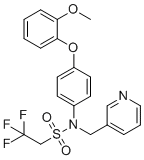
LY-487379 is a potent, selective positive allosteric modulator of mGluR2 (EC50=0.27 uM) without activity at mGluR3; shows no intrinsic agonist or antagonist activity at hmGluR2, markedly potentiates glutamate-stimulated [35S]GTPgammaS binding at hmGluR2; potentiates synaptically evoked mGluR2 responses in rat hippocampal slices, modulates excitatory synaptic transmission in the rat globus pallidus.
More description
|
|
| DC7074 | AZD-3463 Featured |
AZD-3463 is an ALK/IGF1R inhibitor which overcomes multiple mechanisms of acquired resistance to crizotinib.
More description
|

|
| DC8232 | AZD5582 Featured |
AZD5582 is a novel class of dimeric Smac mimetics as potent IAP antagonist; binds potently to the BIR3 domains of cIAP1, cIAP2, and XIAP (IC50 = 15, 21, and 15 nM, respectively).
More description
|

|
| DC8462 | AZD-9291 mesylate (Osimertinib,Mereletinib) Featured |
AZD-9291 is a potent and selective mutated forms EGFR inhibitor(Exon 19 deletion EGFR IC50=12.92 nM, L858R/T790M EGFR IC50= 11.44 nM, wild type EGFR IC50= 493.8 nM).
More description
|

|
| DC42667 | CRT5 Featured |
CRT5 is a pyrazine benzamide that prevents activation of all three isoforms of PKD in endothelial cells treated with VEGF (IC50s = 1, 2, and 1.5 nM for PKD1, PKD2, and PKD3, respectively).
More description
|

|
| DC22988 | BMS-189453 Featured |
BMS-189453 (BMS189453, BMS453) is a synthetic retinoid that acts as an agonist of RARβ and an antagonist of RARα and RARγ.
More description
|

|
| DC33579 | RO2959 Hydrochloride Featured |
RO2959 is a novel, potent and selective CRAC current inhibitor. RO2959 completely inhibited cytokine production as well as T cell proliferation mediated by TCR stimulation or MLR (mixed lymphocyte reaction). RO2959 potently blocked TCR triggered gene expression and T cell functional pathways similar to CsA and another calcineurin inhibitor FK506.
More description
|

|
| DC32533 | TCPOBOP Featured |
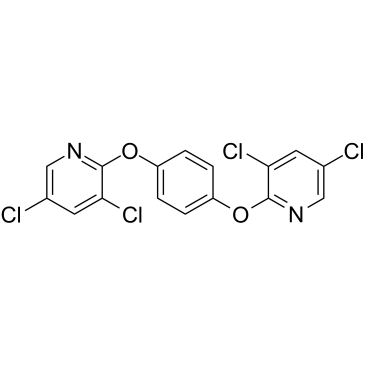
TCPOBOP is an agonist of the constitutive androstane receptor (CAR) (EC50 = 20 nM). TCPOBOP enhances the nuclear receptor CAR transactivation of cytochrome P450 (CYP), as dose-dependent direct agonist of CAR. The most potent known member of the phenobarbital-like class of CYP-inducing agents. TCPOBOP has been used for enhancing Mcl-1-Italics promoter functions in mouse hepatoma cells. TCPOBOP has also been used to study constitutive androstane receptor(CAR)-induced gene expression in mouse hepatocytes.
More description
|
|
| DC11706 | R-10015 Featured |
A potent, selective inhibitor of human LIMK1 with IC50 of 38 nM .
More description
|

|
| DC21486 | PF-05150122 Featured |
PF-05150122 is a potent, state-dependent, subtype selective Nav1.7 inhibitor with IC50 of 21 nM, no significant activity against Nav1.5..
More description
|
|
| DC22137 | LGD2226 Featured |
LGD-2226 (LGD2226) is an orally active, selective androgen receptor modulator (SARM) with binding Ki of 1 nM, >1000-fold selectivity over GR,PR, MR and ER.
More description
|

|
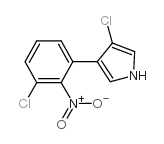
| DC40718 | Pyrrolnitrin Featured |
Pyrrolnitrin is an antibiotic isolated from Pseudomonas pyrrocinia. Pyrrolnitrin shows a broad spectrum of antibiotic activity against fungi, yeast and gram-positive bacteria.
More description
|
|
| DC12497 | (Z)-Azoxystrobin Featured |
Azoxystrobin is a systemic, broad-spectrum fungicide belonging to the class of methoxyacrylates,which are derived from the naturally-occurring strobilurins.
More description
|

|
| DC12033 | (S)-B-973B Featured |
B-973 (B973) is a potent, selective α7 nAChR ago-PAM, denonstrates analgesic effect with attenuating pain behavior and decreasing paw edema in vivo.
More description
|

|
| DC10859 | Baccatin III Featured |
Baccatin III is the precursor to paclitaxel/ taxol. Antileukaemic and antitumor agent isolated from the bark of the Pacific yew tree (Taxus breviofolia).
More description
|

|
| DC9935 | Basmisanil(RG1662) Featured |
Basmisanil is a highly selective inverse agonist/negative allosteric modulator of α5 subunit-containing GABAA receptors which is under development by Roche for the treatment of cognitive impairment associated with Down syndrome.
More description
|

|
| DC10021 | Batefenterol Featured |
Batefenterol(GSK961081,TD-5959)is a Muscarinic Antagonist and β2-Agonist possessing both muscarinic antagonist (MA) and β2-adrenoceptor agonist (BA) properties (MABA).
More description
|

|
| DC12663 | Bax channel blocker(BAI-1) Featured |
Bax channel blocker is a potent inhibitor of Bax-mediated mitochondrial cytochrome C release (IC50 = 0.52 μM). Suggested to inhibit Bax channel formation/activity.
More description
|

|
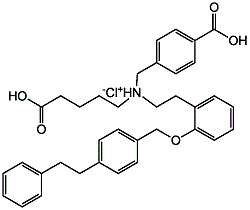
| DC4113 | Cinaciguat (BAY 58-2667) Featured |
BAY 58-2667 is a nitric oxide (NO)- and heme-independent soluble guanylyl cyclase activator. Displays potent cardiovascular effects.
More description
|
|
| DC10660 | BAY 61-3606 free base Featured |
BAY 61-3606 is a potent, ATP-competitive, reversible, and highly selective inhibitor of Syk tyrosine kinase activity (Ki= 7.5 nM) with no inhibitory effect against Btk, Fyn, Itk, Lyn, and Src.
More description
|

|
| DC26010 | BAY-545 Featured |
BAY-545 is a novel, potent and selective antagonist of A2B adenosine receptor with an IC50 of 59 nM. BAY-545 also exhibits IC50s of 66, 400, 280 nM for human, mouse, rat A2Badenosine receptor in cells, respectively.
More description
|

|
| DC11218 | BAY-8002 Featured |
BAY-8002 is a novel potent, selective, orally available monocarboxylate transporter 1 (MCT1) inhibitor (Kd=7.9 nM).
More description
|

|
| DC7372 | Bazedoxifene-Acetate Featured |
Bazedoxifene acetate (TSE 424; WAY-TES 424), a novel selective estrogen receptor modulator (SERM), has been developed to have favorable effects on bone and the lipid profile while minimizing stimulation of uterine or breast tissues.
More description
|

|
