 To enhance service speed and avoid tariff delays, we've opened a US warehouse. All US orders ship directly from our US facility.
| Cat. No. | Product Name | Field of Application | Chemical Structure |
|---|---|---|---|
| DC8888 | Ara-G Featured |
Ara-G (9-β-D-Arabinofuranosyl guanine) is an inducer of apoptosis, inhibitor of DNA synthesis, an antimetabolite, and antineoplastic.
More description
|

|
| DC20265 | Arctigenin Featured |
Arctigenin is an extract from A. lappa, a burdock plant traditionally used in Japanese Kampo medicine for its antioxidant, anti-inflammatory,
More description
|

|
| DC9659 | Arctiin(NSC 315527) Featured |
Arctiin, a plant lignan that can be extracted from the Arctium lappa (burdock) seeds, is a possible environmental endocrine disruptor compounds and have been shown to influence sex hormone metabolism as well as protein synthesis, steroid biosynthesis.
More description
|

|
| DC9645 | (+)-Arglabin Featured |
Arglabin is a sesquiterpene gamma-lactone is isolated from Artemisia glabella; anticancer natural compound.
More description
|

|
| DC10110 | ARM390 Hydrochloride Featured |
ARM390 is a non-peptidic, low-internalizing δ-selective opioid receptor agonist.
More description
|

|
| DC7064 | Apalutamide(ARN509) Featured |
ARN-509 is a selective and competitive androgen receptor inhibitor with IC50 of 16 nM, useful for prostate cancer treatment.
More description
|

|
| DC8816 | ARS-853 Featured |
ARS-853 is a selective, covalent inhibitor of KRAS-G12C that inhibits mutant KRAS driven signaling by binding to the GDP bound oncoprotein and preventing activation.
More description
|

|
| DC9840 | AS-8351 Featured |
AS 8351 induces reprogramming of human fetal lung fibroblasts into functional cardiomyocytes, in combination with CHIR 99021, A83-01, BIX 01294, SC1, Y-27632, OAC2, SU 16f and JNJ 10198409.
More description
|

|
| DC11460 | AS604850 Featured |
AS-604850 is a selective, ATP-competitive PI3Kγ inhibitor with IC50 of 250 nM, over 80-fold selectivity for PI3Kγ than PI3Kδ/β, and 18-fold more selective for PI3Kγ than PI3Kα.
More description
|

|
| DC10781 | ASK1-IN-1 Featured |
ASK1-IN-1 is an apoptosis signal regulating kinase 1 (ASK1) inhibitor extracted from patent WO2016025474A1, Compound 4.
More description
|

|
| DC20218 | ASP5878 Featured |
ASP5878 is a selective FGFR inhibitor, to treat FGFR3-dependent urothelial cancer with or without chemoresistance.
More description
|

|
| DC10588 | ASP-9521 Featured |
ASP-9521 is a potent, selective and orally available AKR1C3 inhibitor with an IC50 of 11 nM for human AKR1C3.
More description
|

|
| DC11447 | Astragaloside IV Featured |
Astragaloside IV, an active component isolated from Astragalus membranaceus, suppresses the activation of ERK1/2 and JNK, and downregulates matrix metalloproteases (MMP)-2, (MMP)-9 in MDA-MB-231 breast cancer cells.
More description
|

|
| DC23072 | Atractylenolide II Featured |
Atractylenolide II has antiinflammatory activity, it can inhibit platelets activities and thrombus formation. Atractylenolide II has cytotoxic/apoptotic effects may via p38 activation ,ERK and Akt inactivation, p53 dependent, it also has antimelanoma effe
More description
|

|
| DC23073 | Atractylenolide III Featured |
Atractylenolide III, a potential house dust mite control agent, has neuroprotection, gastroprotective, anti-cancer, and anti-inflammatory activities, it also may control immunological reactions by regulating the cellular functions of IL-6 in mast cells.
More description
|

|
| DC23059 | Atractylon Featured |
Atractylone has inhibitory effects on mast cell-mediated allergic reactions, it regulates the degranulation of mast cell, proves its potential in the treatment of mast cell-mediated allergic reactions.
More description
|

|
| DC10018 | Atrasentan hydrochloride Featured |
Atrasentan Hcl(A-147627) is an endothelin antagonist receptor (IC50=0.0551 nM, ETA) being developed for the treatment of prostate cancer.
More description
|

|
| DC10552 | AU1235 Featured |
AU1235 is an adamantyl urea inhibitor of Mycobacterium tuberculosis.
More description
|

|
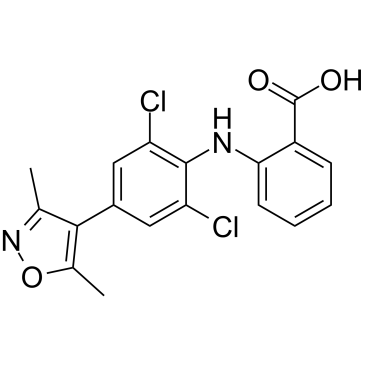
| DC41025 | FB23 Featured |
FB23 is a potent and selective FTO demethylase inhibitor with an IC50 of 60 nM. FB23 directly binds to FTO and selectively inhibits FTO's mRNA N6-methyladenosine (m6A) demethylase activity.
More description
|
|
| DC8799 | Avanafil(TA-1790) Featured |
Avanafil(TA-1790) is a potent and highly selective phosphodiesterase-5(PDE-5) inhibitor(IC50=5.2 nM) for erectile dysfunction; lower selectivity against PDE1, PDE6, and PDE11.
More description
|

|
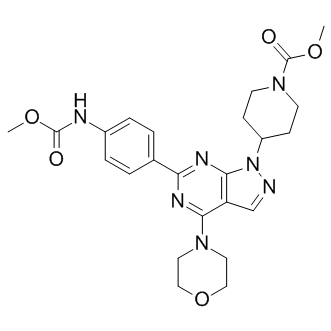
| DC8552 | WYE-354 Featured |
WYE-354 is a potent cell-permeable inhibitor of mTOR (IC50 = 4.3 nM) which blocks signaling through both mTOR complex 1 (mTORC1) and mTORC2.1,2 It is a much weaker inhibitor of phosphatidylinositol 3-kinase α (IC50 = 1026 nM) and other kinases.3 WYE-354 i
More description
|
|
| DC9347 | N-desmethyl Enzalutamide Featured |
N-desmethyl Enzalutamide(N-desmethyl MDV3100) is a major metabolite of Enzalutamide, Enzalutamide(MDV3100) is an androgen-receptor (AR) antagonist with IC50 of 36 nM.
More description
|

|
| DC10732 | Anavex-2-73 free base (Blarcamesine) Featured |
AVex-73 is a muscarinic M1 agonist potentially for the treatment of Alzheimer's disease
More description
|

|
| DC10009 | Avitinib free base Featured |
Avitinib is an orally available, irreversible, epidermal growth factor receptor (EGFR) mutant-selective inhibitor, with potential antineoplastic activity.
More description
|

|
| DC10008 | Avitinib maleate Featured |
Avitinib is an orally available, irreversible, epidermal growth factor receptor (EGFR) mutant-selective inhibitor, with potential antineoplastic activity.
More description
|

|
| DC10927 | NIK inhibitor 4f(NIK SMI1) Featured |
NIK SMI1 is a potent, selective small molecule inhibitor of NF-κB inducing kinase (NIK) with Ki of 230±170 pM; only inhibits 3 out of 222 off-target kinases (KHS1, LRRK2, and PKD1) with >75% inhibition at 1 uM; potently inhibits anti-LTβR-induced nuclear p52 levels in anti-LTβR-stimulated HeLa cells, with no effect on canonical signaling; inhibits BAFF and CD40 signaling, suppresses immune responses in vivo; suppresses disease biomarkers and improves survival and renal function in NZB/W F1 mice.
More description
|

|
| DC22304 | ILK-IN-2 (CPD 22: OSU-T315 analog) Featured |
ILK-IN-2 (OSU-T315 analog) is a ILK inhibitor.
More description
|

|
| DC7746 | AZ191 Featured |
AZ191 is a potent and selective DYRK1B inhibitor with IC50 of 17 nM, about 5- and 110-fold selectivity over DYRK1A and DYRK2, respectively.
More description
|

|
| DC12376 | AZ304 Featured |
AZ304 is a novel potent, dual BRAF inhibitor targeting the kinase domains of wild type BRAF, V600E mutant BRAF and wild type CRAF with IC50 of 79 nM, 38 nM and 68 nM, respectively.
More description
|

|
| DC10906 | AZ31 Featured |
AZ31 is a novel ATM inhibitor.
More description
|

|
